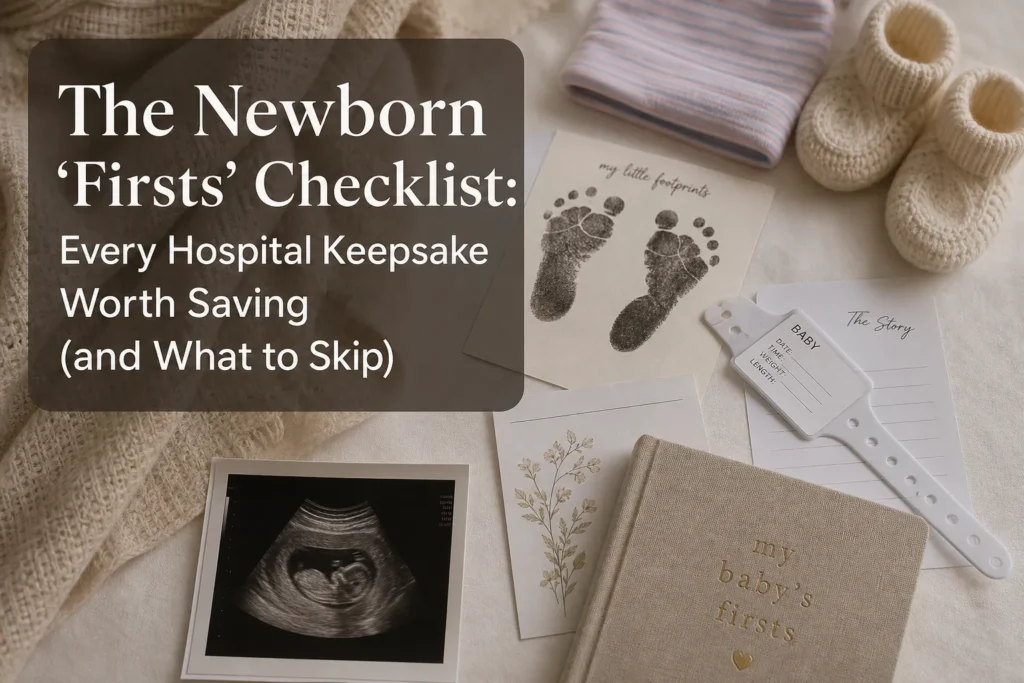
The Newborn “Firsts” Checklist: Every Hospital Keepsake Worth Saving (and What to Skip)
The newborn stage moves fast, and the hospital part moves fastest of all. You’re tired, emotional, probably running on adrenaline, and somehow expected to remember which little paper card or tiny hat is worth saving.
If that already feels overwhelming, here’s the good news: you do not need to save everything.
At Tiny Moments Kept, we always come back to the same principle: memory keeping works better when it stays small, visible, and meaningful. A good newborn keepsakes checklist should help you notice the few things that truly tell the story of your baby’s first days, not send you home with a bag of random paper and clutter.
This guide is tightly focused on the birth and newborn hospital window only: what to save, what to photograph, what to ask for before discharge, and what to skip without guilt.
What most newborn keepsake lists miss
Most competitor articles do a decent job listing items like bracelets, footprints, and the coming-home outfit. But they often miss the parts that actually help busy parents:
-
How to decide quickly in the moment
-
Which items are often thrown away by accident
-
What should stay physical vs. what is better digitized
-
How to store fragile hospital items without turning memory keeping into a big project
-
How to curate instead of keeping every duplicate
That curation piece matters most. If you already know you prefer a calmer home and fewer unfinished projects, you may like our minimalist approach to meaningful memory keeping, because the same principle applies here: keep the story, not the pile.
The simple rule: save what tells the story of this exact baby, in this exact moment
When you’re deciding between keepsakes in the hospital, ask:
-
Does this mark a true first?
-
Would I miss it later if it disappeared?
-
Can a photo do the job just as well?
If the answer to the first two is yes, keep it.
If the answer to the third is yes, photograph it and let it go.
That one filter keeps your hospital keepsakes baby collection from becoming a drawer full of things you never revisit.
The newborn hospital keepsake checklist
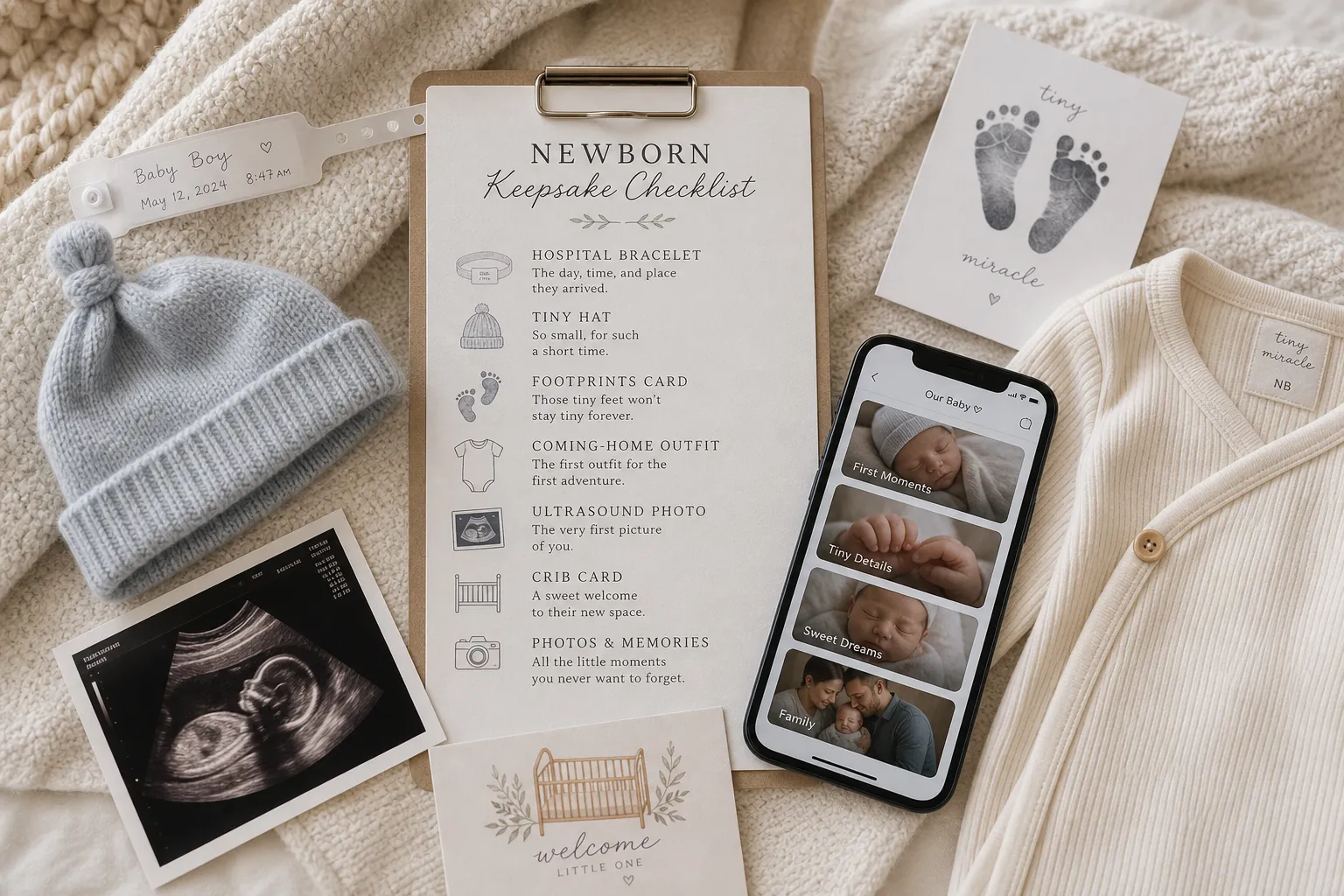
Use this as your practical first keepsakes newborn guide. Each item below includes why it matters and the easiest way to store it.
1. Hospital bracelet
Keep the baby bracelet, and if you want, one parent bracelet too.
Why it matters: It’s one of the clearest “this was the beginning” objects.
How to store it: Slip it into a small archival envelope or acid-free sleeve so the plastic doesn’t snag other items.
2. Hospital bassinet name card
This is the little card or printout with baby’s name and details that may sit on the bassinet.
Why it matters: It’s plain, easy to overlook, and surprisingly specific to those first hours.
How to store it: Keep flat in a document sleeve.
3. Footprint card
If your hospital provides footprints, save the original.
Why it matters: This is one of the most classic newborn hospital mementos, and often one of the few items with your baby’s exact tiny scale preserved on paper.
How to store it: Store flat in an acid-free sleeve and keep it away from moisture.
“Many hospitals provide these footprint cards to families as mementos, but they may not retain copies themselves. Therefore, the footprint card you receive at discharge might be the only copy made.” – LegalClarity
4. First hat
Save the small knit hospital hat if your baby wore one.
Why it matters: It’s instantly recognizable as newborn-sized and often becomes one of the most emotionally powerful objects later.
How to store it: Wash only if needed, let it dry fully, and store in tissue paper or a fabric pouch.
5. Coming-home outfit
Choose just one outfit: the one your baby actually wore home.
Why it matters: It connects memory to a real transition, not just a cute outfit.
How to store it: Fold neatly with acid-free tissue. Add a note with the date and baby’s approximate weight.
6. Swaddle or hospital blanket corner
You do not need every blanket. Save one only if it carries a strong memory.
Why it matters: Some families remember the first swaddle more than the outfit.
How to store it: If the blanket is large, cut nothing. Either keep the whole item if small enough, or skip the object and keep a photo instead.
7. First photo from the hospital
Print one favorite image rather than leaving it buried on your phone.
Why it matters: The newborn period can become a blur. One printed photo anchors the whole set of keepsakes.
How to store it: Write the date, place, and one line on the back: “A few hours old, still sleepy, Dad crying behind the camera.”
8. Ultrasound image you truly care about
Not every ultrasound print needs to be saved.
Why it matters: If one image was especially meaningful, include it. If you feel nothing looking at the stack, skip them.
How to store it: Keep one best print in a sleeve; photograph the rest if needed.
9. Birth announcement or hospital welcome card
Keep one clean version.
Why it matters: It holds the basic facts and often becomes useful when putting together a memory box later.
How to store it: Flat with paper keepsakes.
10. NICU, special care, or medical milestone note if relevant
If your baby spent time in the NICU or had a significant early medical event, keep one document or write your own summary.
Why it matters: These details are often emotionally important later, even when you don’t want to keep every clinical paper.
How to store it: Keep only one or two representative items plus a short written note in your own words.
11. One written memory from a parent
This is not a hospital-issued item, but it belongs in the box.
Why it matters: Objects tell you what happened. A sentence tells you how it felt.
How to store it: Add an index card, note card, or printed note with 3–5 lines.
A good prompt:
-
What surprised me most
-
What your baby looked like
-
What the room felt like
-
What I want to remember before I forget
If you want help getting words down quickly, this fill-in-the-blank memory journal template makes it easier to write something now instead of hoping you’ll do it later.
12. A photo of the whole hospital setup
Take a wide shot: bassinet, blanket, monitor corner, flowers, dim room light.
Why it matters: Context is often what disappears first from memory.
How to store it: Digital is perfect here. Add it to a “Birth Week” album.
What to photograph instead of saving
Some things matter emotionally but do not need physical storage.
Best items to keep digital only
|
Item |
Why a photo is enough |
Best tip |
|---|---|---|
|
Whiteboard with baby’s stats |
Large, temporary, easy to capture |
Photograph straight-on in good light |
|
Hospital room |
Context matters more than the object |
Take one wide shot and one close detail |
|
First diaper/cart setup |
Useful for storytelling, not storage |
Add a note in album caption |
|
Flowers or gifts |
Meaningful but bulky |
Take one photo with card attached |
|
Hospital paperwork stack |
Most is administrative, not sentimental |
Photograph cover pages only if meaningful |
|
Extra blankets or linens |
Too bulky to store well |
Keep one image, not the object |
What to ask for before discharge
This is one of the biggest content gaps in most articles: sometimes the keepsake exists, but no one hands it to you automatically.
Before you leave, ask politely whether you can keep or receive:
-
Baby footprint card
-
Extra name card or crib card
-
One hat or blanket if allowed
-
Printed birth stats if available
-
Any celebratory sign used in photos
-
NICU milestone cards or special-unit memory items, if relevant
Not every hospital offers all of these, and policies vary. But asking once before discharge is easier than trying to track it down later.
What to skip without guilt
Here’s the part many parents need most: permission to leave things behind.
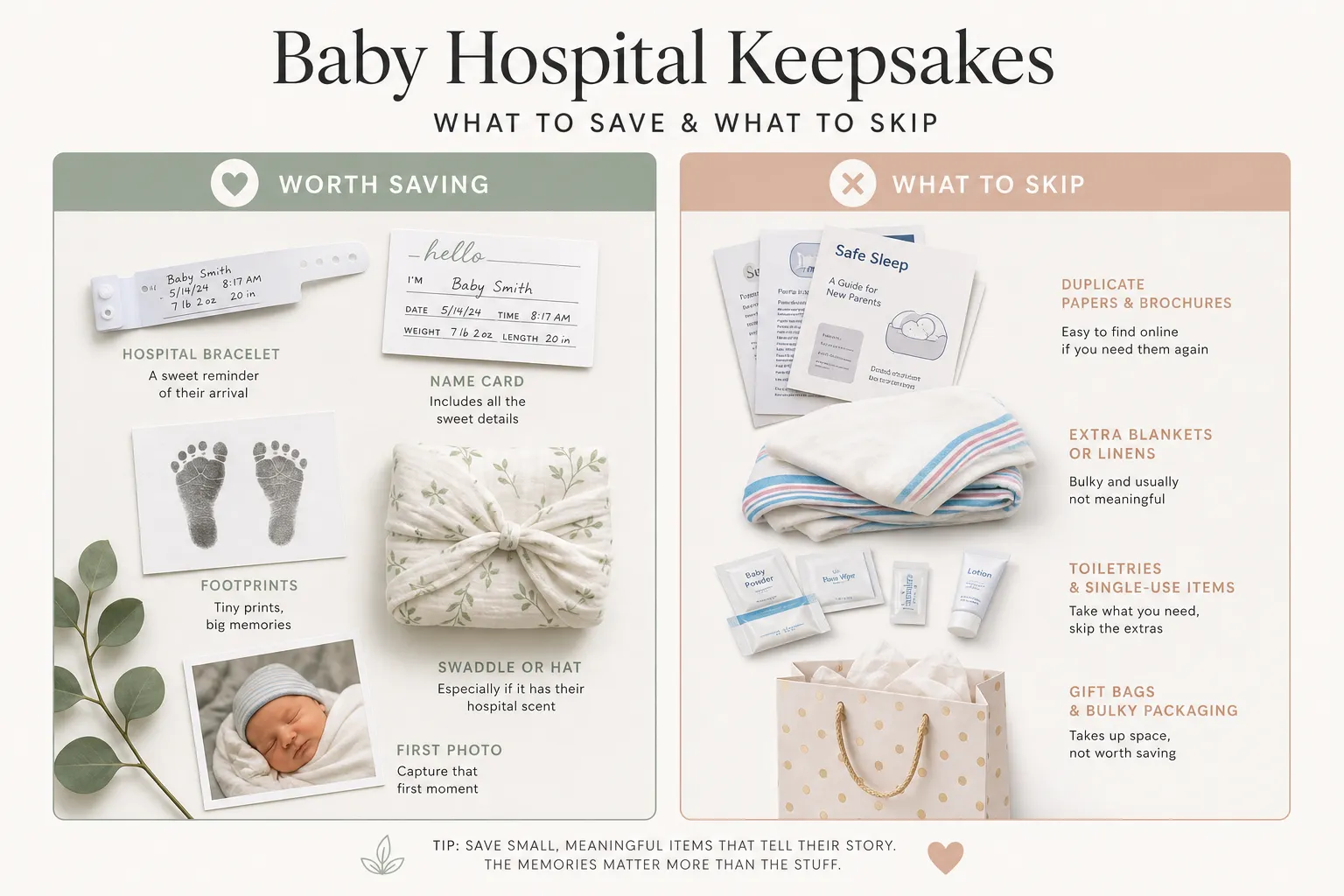
Skip duplicates
If you have five similar photos or three versions of the same announcement, keep one.
Skip paperwork with no emotional value
Billing pages, generic instructions, and duplicate discharge papers rarely become meaningful keepsakes.
Skip bulky items you won’t revisit
Full blankets, gift bags, packaging, and product samples usually become storage clutter.
Skip damaged or stained items
If it cannot be stored cleanly and safely, a photo is enough.
Skip “maybe someday” items
If you are only keeping it because you feel guilty throwing it away, that’s usually your answer.
A gentle note on Japanese memory keeping: heso no ito
In Japan, some families keep a baby’s dried umbilical cord in a small box. The custom is called heso no ito, and it’s a very specific newborn keepsake tradition tied to birth and the bond between parent and child.
Not every Japanese family does this, and hospitals in the US generally handle cord remnants differently, so this may or may not be possible in your situation. But the practical takeaway is useful for any family: one tiny object from birth can hold a lot of meaning when it is intentionally stored and clearly labeled. If you’re curious about the tradition itself and how families adapt it today, you can read more about heso no ito, the Japanese tradition of keeping your baby’s umbilical cord.
How to store newborn hospital keepsakes without creating another unfinished project
You do not need a scrapbook, a craft cart, or a perfect baby book to do this well.
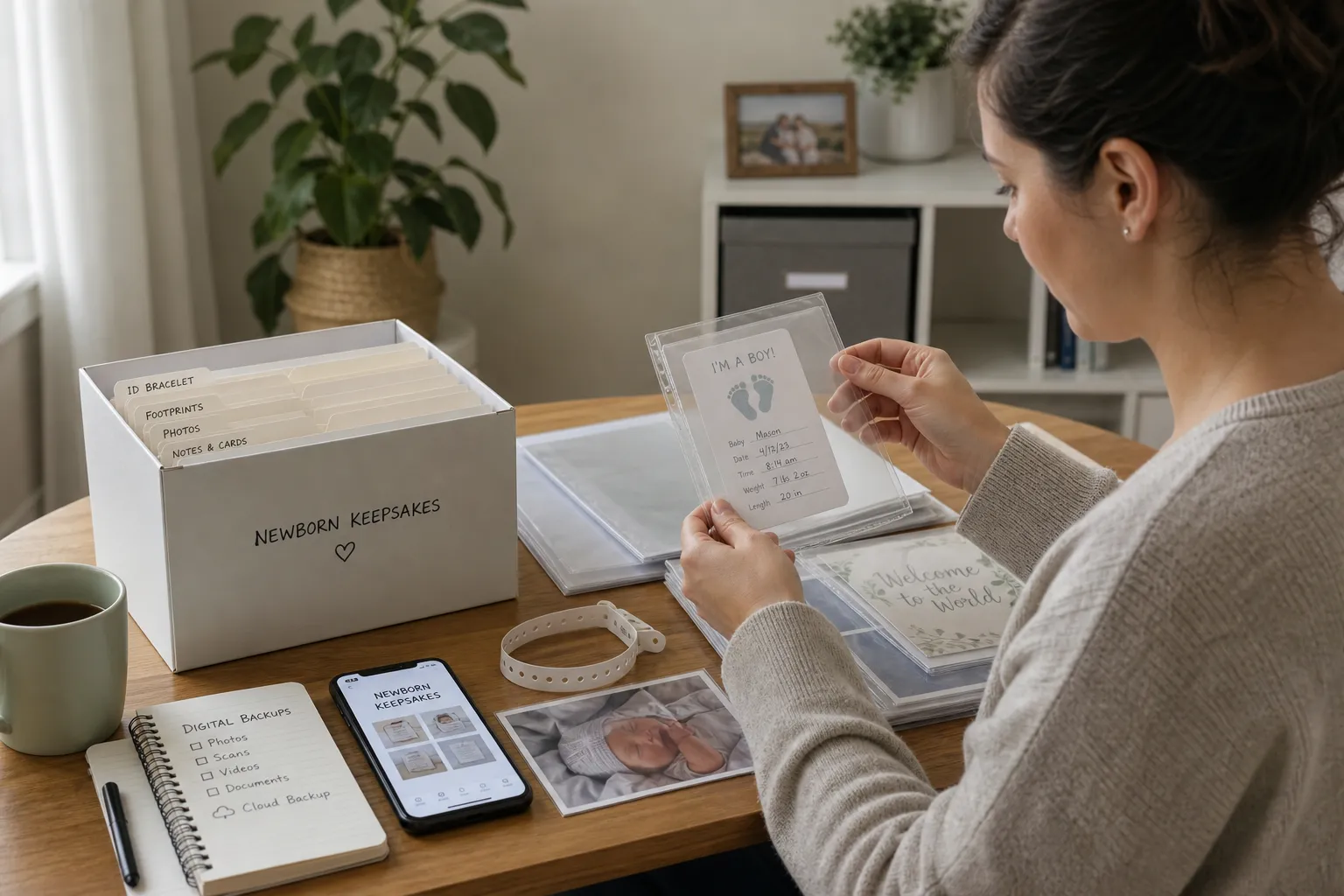
The easiest storage system
Use one small archival box or sturdy envelope file with:
-
acid-free sleeves for paper
-
one pouch for fabric items
-
one card for your written memory
-
one digital album on your phone labeled “Birth + Hospital”
That’s enough.
Label everything once
On a small note or index card, write:
-
baby’s full name
-
birth date
-
hospital name
-
what each item is
Future you will be grateful.
Pair physical and digital on purpose
A simple split works best:
-
Physical: bracelet, hat, footprints, outfit, one note
-
Digital: room photos, duplicate images, flowers, paperwork snapshots
This is one of the simplest ways to preserve childhood memories without turning it into a large organizing system later.
A quick checklist you can screenshot
Save these physical keepsakes
-
Hospital bracelet
-
Bassinet or name card
-
Footprint card
-
First hat
-
Coming-home outfit
-
One meaningful swaddle or blanket, if truly memorable
-
One printed hospital photo
-
One meaningful ultrasound print
-
Birth announcement or welcome card
-
One parent note about the first day
Capture these digitally
-
Hospital room
-
Whiteboard or stat board
-
First bassinet setup
-
Flowers and gifts
-
Extra paperwork covers
-
Duplicate photos
-
Special details like crib sign, monitors, or tiny hands in hospital blanket
Skip these
-
Duplicate paper items
-
Generic handouts
-
Bulky extras
-
Damaged keepsakes
-
Anything you feel obligated, rather than glad, to keep
Why this small checklist matters more than a giant memory box
The real goal is not to prove you saved enough. It’s to preserve a few vivid, revisit-able pieces of the story.
That’s the Tiny Moments Kept approach: keep fewer things, choose better things, and make sure they are easy to see again. A carefully chosen set of newborn keepsakes will mean more in ten years than an overstuffed bin you never open.
And if you want to build a memory-keeping rhythm that stays simple after the hospital stage, Tiny Moments Kept is here to help you do it without clutter, guilt, or perfectionism.
FAQ
What is the 3 3 3 rule for newborns?
The “3 3 3 rule” is not a formal medical guideline for newborn care. Some parents use it informally to describe rough adjustment periods, but for your baby’s first days, it’s better to focus on feeding, safe sleep, and a few meaningful keepsakes rather than trying to follow social-media rules of thumb.
What are the absolute must-haves for a newborn?
The true essentials are a safe sleep space, feeding supplies, diapers, clothing, and a properly installed car seat. If you mean keepsakes rather than gear, the simplest must-saves are the hospital bracelet, footprint card, first hat, and one printed photo.
What is the 5 5 5 rule for newborns?
The “5 5 5 rule” usually refers to postpartum recovery advice for the birthing parent, not the baby: roughly 5 days in bed, 5 days on the bed, and 5 days around the bed. It’s a rest guideline, not a strict medical rule, and families should always follow their own care provider’s advice.
What is the 3 6 9 rule for babies?
The “3 6 9 rule” is not a standard pediatric rule and can mean different things online. For newborns, the more useful approach is to keep things practical: track your baby’s care with your pediatrician, and save only the few first keepsakes that clearly tell the birth story.
At what age is SIDS no longer a risk?
SIDS risk is highest between 1 and 4 months, and about 90% of cases happen before 6 months. The risk drops significantly after that, but safe sleep habits are recommended throughout the first year.
When can you stop waking a newborn every 3 hours?
This depends on your baby’s weight gain, feeding, and pediatrician’s guidance. Many families are told they can stop waking baby once the newborn is feeding well and back to birth weight, but always confirm that with your own care provider.
“The risk of SIDS is highest between 1 and 4 months of age, with approximately 90% of cases occurring in infants younger than 6 months.” – Sleep Foundation