
A Fill-in-the-Blank Memory Journal Template You Can Use Tonight
If you’ve been meaning to start a memory journal but keep getting stuck on how to do it, this is for you.
Not a long explanation. Not a perfect scrapbook system. Just a simple, practical template you can print or copy into a notebook tonight.
For many parents, the hardest part of memory keeping isn’t caring enough. It’s the opposite. You care so much that the photos pile up, the baby books stay half-finished, and the pressure to “do it right” turns into doing nothing at all. At Tiny Moments Kept, we believe a good memory-keeping system should be easy to keep up with, easy to revisit, and focused on what actually matters.
A simple fill-in page works because it removes decision fatigue. You don’t have to wonder what to write. You just answer a few concrete prompts and move on.
“A 2026 survey by Popsa found that 70% of smartphone photos are never revisited.” – Digital Information World
That number is exactly why a short written note matters. A photo shows a face. A sentence preserves the story.
If you’re trying to build a calmer system for family memories, you may also like this guide to a minimalist approach to meaningful memory keeping.
Why this kind of memory journal actually gets used
Most memory books fail for one of three reasons:
they ask too much of you
they only work for major milestones
they turn into another unfinished project
A fill-in-the-blank format solves all three. It gives you structure without making you write an essay. It works for ordinary Tuesdays, not just birthdays and first steps. And it keeps memory keeping small enough to continue.
This is especially helpful if you want a memory keeping journal that feels sustainable instead of decorative.
What makes a good fill-in-the-blank memory journal template
The best template should be:
Feature | Why it matters |
|---|---|
Short | You can finish it in 3–5 minutes |
Specific | Concrete prompts lead to better memories later |
Flexible | Works for babies, toddlers, school-age kids, and family life in general |
Repeatable | Same format each week or month reduces friction |
Emotionally useful | Captures voice, personality, and context, not just dates |
Competitor articles often give long lists of notebook ideas, but they usually stop there. What’s missing is the actual done-for-you page: what to write, in what order, and how to make it simple enough to keep going.
That’s the gap this article is meant to fill.
The fill-in-the-blank memory journal template
You can copy this into a notebook, save it in your notes app, or turn it into your own memory journal template printable.
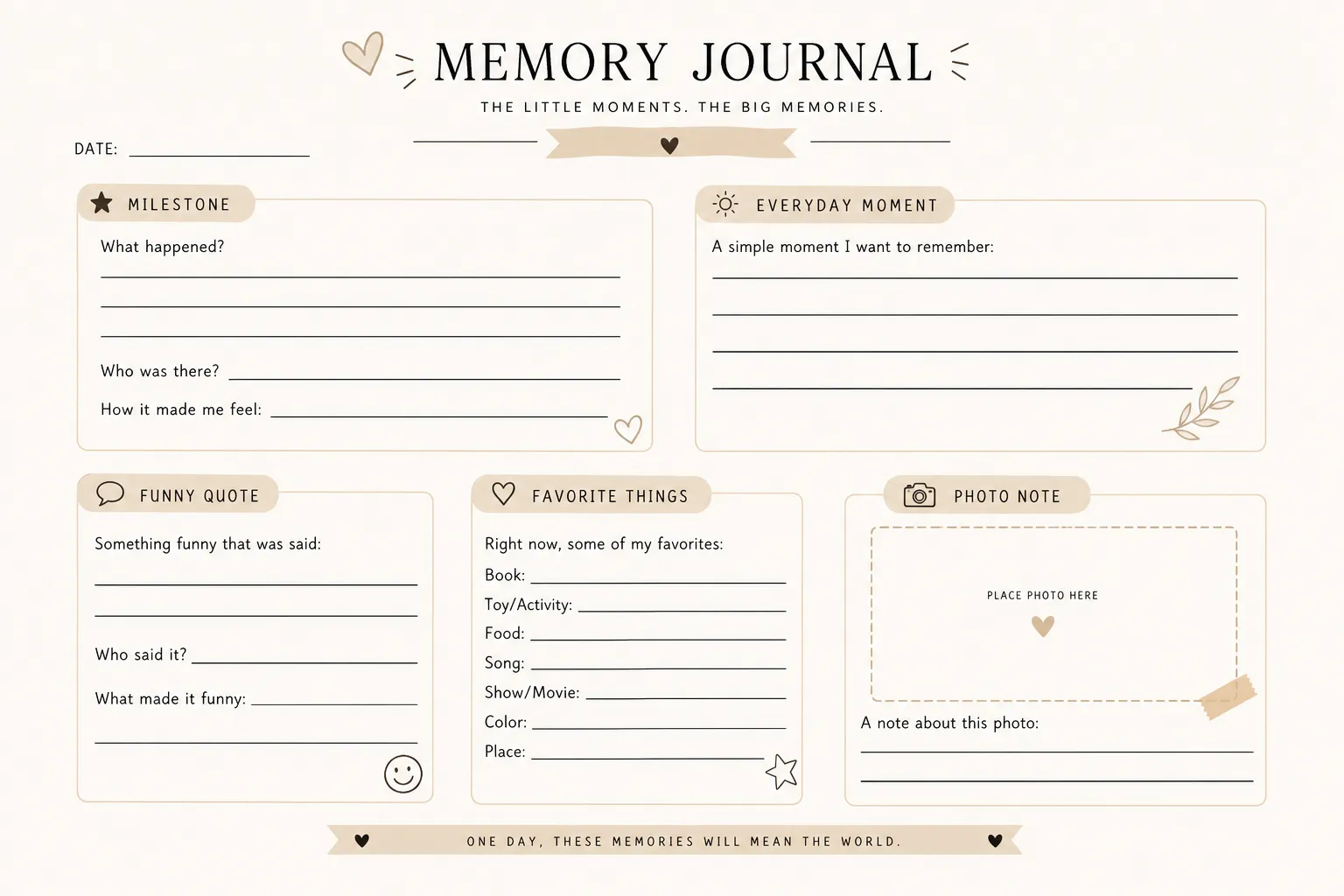
Simple weekly memory journal page
Date: __________
Child’s age: __________
Place: __________
This week, my child was really into:
Something they said that I want to remember:
“______________________________________”
Something they did that felt very “them”:
A tiny ordinary moment I don’t want to forget:
Something hard right now:
Something that is getting easier:
What made me laugh:
What they are loving lately:
Food: _________________________________
Song/show/book: _______________________
Toy/activity: ___________________________
A detail about them right now:
One photo I took this week that matters, and why:
If I could freeze one moment from this week, it would be:
Note to my future self:
A one-page nightly version you can do in 2 minutes
If weekly feels too ambitious, use this nightly version.
Two-minute nightly memory page
Today’s date: __________
Today my child said:
“______________________________________”
Today they loved:
Today was hard because:
Today was sweet because:
One thing I want to remember about today:
This version is ideal for the season when you are tired, behind on laundry, and absolutely not starting a complicated keepsake project.
Prompts organized by type
A good set of family memory journal prompts should help you capture more than milestones. The best memories are often oddly specific: the mispronounced word, the rain boots in July, the way your child insisted on sleeping with three plastic dinosaurs.
Below are prompt sets you can rotate through.
Milestone prompts
Use these when something new happens.
Firsts and big changes
Today was the first time they __________.
They seemed to feel __________ about it.
I felt __________ watching it happen.
The smallest detail I want to remember is __________.
What surprised me most was __________.
School and growth markers
Their current favorite thing about school is __________.
A new skill they’re proud of is __________.
The teacher/friend/sibling moment I want to remember is __________.
Right now they are becoming more __________.
Compared with six months ago, they seem more __________.
Birthday snapshot
At age __________, they love __________.
They keep talking about __________.
Their funniest habit right now is __________.
They are struggling with __________.
I hope they always keep their __________.
Everyday moment prompts
These are often the most valuable pages later.
Home life
Right now, our mornings look like __________.
Their usual breakfast request is __________.
The shoes/clothes/costume they keep choosing are __________.
The thing they ask me to do over and over is __________.
The part of the day when they seem most themselves is __________.
Funny and specific details
A word they say in a funny way is __________.
The strange thing they are deeply attached to right now is __________.
They are currently pretending to be __________.
The question they keep asking lately is __________.
Their latest completely unreasonable opinion is __________.
Parent memory prompts
I lost my patience when __________.
I felt proud when __________.
I noticed they are changing because __________.
I wish I could remember forever the way they __________.
The part of parenting this age that no one explains well is __________.
Childhood details prompts
These are the details that disappear fastest.
Personality snapshot
Right now, they are brave about __________ but cautious about __________.
They are most affectionate when __________.
They get frustrated when __________.
They light up when __________.
If I had to describe them in three words today: __________, __________, __________.
Favorites snapshot
Favorite snack: __________
Favorite song: __________
Favorite book: __________
Favorite person to play with: __________
Favorite phrase: __________
Favorite place to go: __________
Body language and habits
When they are tired, they __________.
When they are excited, they __________.
Their current bedtime habit is __________.
They still need me to __________.
I know this phase will end someday: __________.
A seasonal template you can reuse all year
Instead of trying to keep up daily, many families do better with a seasonal page every 3 months.
Seasonal family memory page
Season: __________
Year: __________
Child’s age: __________
What life looks like in this season:
What our weekends usually include:
What my child is talking about all the time:
What they are wearing on repeat:
What feels easy right now:
What feels tender or difficult right now:
One family routine I hope we remember:
One photo that sums up this season:
This is a good format if you want to preserve childhood memories in a simple way without creating stacks of unfinished albums.
A Japanese memory-keeping idea worth borrowing: writing down the exact words
In many Japanese families, certain keepsakes are saved not because they are fancy, but because they hold a specific moment in a child’s life. One example is heso no o, the dried umbilical cord traditionally kept in a small box after birth. It is not useful in a practical sense. Its value is entirely emotional and symbolic: a physical marker that says, this beginning mattered.
For everyday family memory keeping, you can borrow the same logic without copying the object itself. Instead of saving everything, save the things that clearly mark connection and change.
One of the best ways to do that is to write down your child’s exact words.
Use this “exact words” mini-template
Date: __________
Context: ________________________________________
What they said:
“______________________________________”
Why it mattered / why it was funny / what it revealed:
This works especially well for:
toddler mispronunciations
sibling conversations
serious questions
surprisingly kind comments
odd little observations that reveal personality
These small verbal snapshots often become the most revisited part of a journal.
How to make your template printable and usable
You do not need special software. Keep it plain.
Best formats
Format | Best for | Why it works |
|---|---|---|
Printed loose pages | Parents who want quick access | Easy to fill out and file |
Bound notebook | Parents who like everything together | No loose paper clutter |
Notes app template | Busy evenings and travel | Always available |
Monthly binder | Families managing multiple kids | Easy to sort by child or year |
Simple setup tips
Keep one master template only.
Print 10 copies at a time instead of making a new design every month.
Store completed pages in one folder or slim binder.
Tape in one photo only if it truly adds context.
Date every page, even if you write only two lines.
The simpler the setup, the more likely you are to keep going.
What to skip if you want this to last
If you’ve abandoned journals before, it usually wasn’t because you were lazy. It was because the system asked too much.
Skip:
elaborate layouts
pressure to write every day
saving every school paper
rewriting rough notes into a prettier version
prompts that are too vague to answer
A useful memory journal should reduce clutter, not create another layer of it. That idea sits at the heart of Tiny Moments Kept: preserve what truly matters, and make it easy to see again later.
A simple rhythm that works for busy parents
Here is a realistic schedule:
Option 1: Weekly
Fill out one page every Sunday night.
Option 2: Monthly
Choose 3 prompts and one favorite photo.
Option 3: Seasonal
Do one fuller page every three months.
Option 4: Event-based
Write only when something changes: first haircut, lost tooth, new school, funny phase, big feelings.
If you want something sustainable, choose the smallest rhythm you can actually maintain.
“Writing about emotional experiences can lead to significant improvements in both physical and psychological health.” – Simply Psychology, summarizing James Pennebaker’s expressive writing research
That matters here too. A memory journal is not just an archive. It also helps you notice what is happening while you are living it.
Sample filled-out page
Sometimes the hardest part is seeing what “good enough” looks like.
Example
Date: April 18
Child’s age: 4 years 2 months
Place: Home
This week, my child was really into:
Making a “nest” on the couch with every blanket in the house.
Something they said that I want to remember:
“I’m not little, I’m just still growing.”
Something they did that felt very “them”:
Brought her stuffed rabbit a tiny cup of water because “everyone gets thirsty.”
A tiny ordinary moment I don’t want to forget:
Her standing on a chair in mismatched pajamas helping stir pancake batter.
Something hard right now:
Huge feelings at pickup time.
Something that is getting easier:
Bedtime.
What made me laugh:
She wore rain boots with a swimsuit in the backyard and called it “vacation clothes.”
One photo I took this week that matters, and why:
The pancake photo, because it shows the gap-toothed smile and the yellow bowl from my own childhood.
That is enough. Truly.
If you have more than one child
Do not create separate complicated systems unless you love that kind of organization.
Instead, try:
one binder, tabs by child
one notebook, different ink color for each child
one page per child each month
one shared family page plus one child-specific detail line
The goal is not equal volume. It is fair attention over time.
What to do with completed pages
Once you fill pages out, keep them visible enough to revisit.
Good options
store them in a slim annual binder
hole-punch and group by year
scan them into one folder
pair a few pages with photos at the end of the year
choose 10–20 pages total to turn into a family keepsake book later
If you want ideas for deciding what deserves space, this guide on keepsakes that matter most for family memories can help.
Final takeaway
You do not need a perfect baby book. You do not need a craft cart. You do not need to catch up on five years of memories before you begin.
You need one page.
A simple fill-in-the-blank journal page can hold the details that photos miss: the exact phrase, the current obsession, the bedtime habit, the version of your child that exists only right now.
That is the Tiny Moments Kept approach in its simplest form: less pressure, less clutter, more meaning. Start tonight with one page, and let the system stay small enough to survive real family life.
FAQ
What are some ideas for filling a memory book?
You can fill a memory book with milestones, funny quotes, favorite things, ordinary routines, school moments, seasonal snapshots, and small personality details. The best pages are often the specific everyday moments you would not think to save otherwise.
What is the 3-3-3 journaling method?
The 3-3-3 journaling method usually means writing three things that happened, three feelings, and three next steps or reflections. For family memory keeping, you can adapt it into three moments, three quotes, and three details about your child right now.
How to create a memory journal?
Start with a simple repeatable template instead of a complicated scrapbook. Choose a format you can stick with, such as a notebook, printed page, or notes app, and fill out a few concrete prompts each week or month.
What is the 3 2 1 method of journaling?
The 3-2-1 method often means recording 3 things you noticed, 2 things you felt, and 1 thing you want to remember. It works well for parents because it keeps journaling short while still capturing emotion and detail.
What to put in a memory journal?
Include exact words your child said, current favorites, daily routines, milestone notes, hard seasons, funny habits, and one meaningful photo note. These details help you revisit not just what happened, but what family life actually felt like.
What are some good memories examples?
Good memory examples include a first lost tooth, a child’s mispronounced word, pancakes in pajamas, a favorite bedtime book, nervousness on the first school day, or a surprisingly kind comment. Small ordinary memories often become the most precious later.