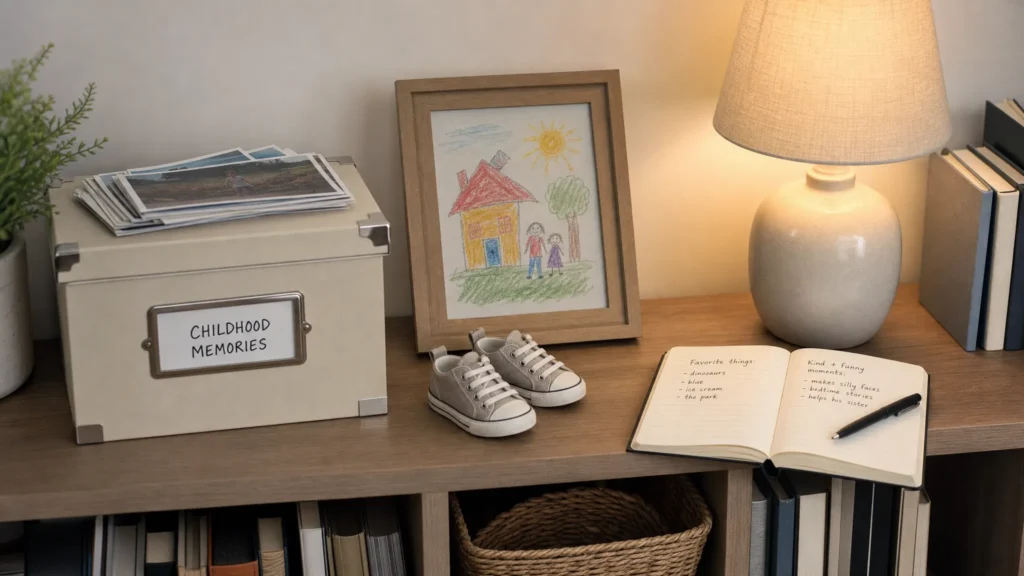
Preserving childhood memories can feel strangely heavy. You want to remember the baby curls, the funny mispronunciations, the scribbled drawings, the way your child ran to the door at pickup. But you are also tired, busy, and surrounded by too many photos, too much paper, and too many half-started projects.
The good news is that memory keeping does not have to become a second job. The most meaningful family archives are often built from small, steady habits, not elaborate scrapbooks or perfectly labeled boxes. A few chosen moments, saved with care and context, can say more than thousands of forgotten files on a phone.
This guide is for parents who want simple ways to preserve childhood memories without turning the process into another source of guilt. Think of it as a softer system, one that helps you notice what matters, keep only what feels alive, and make those memories easy to revisit later.
Start by Redefining What Is Worth Keeping
Before choosing a storage box or photo app, it helps to decide what you are actually trying to preserve.
You are not trying to keep proof that your child had a beautiful childhood. You are preserving traces of who they were, how your family loved one another, and what ordinary life felt like in this season.
That might include:
- A photo of your child asleep in a pile of stuffed animals
- A note about the song they asked for every night
- A drawing that shows how they saw the world at age four
- A video of their laugh, even if the kitchen is messy in the background
- A tiny pair of shoes that instantly brings back their toddler walk
The goal is not to save everything. It is to save enough. When you keep fewer things with more meaning, you create an archive that feels warm instead of crowded. If you are drawn to this calmer philosophy, Tiny Moments Kept also explores a minimalist approach to meaningful memory keeping that can help you choose with more confidence.
Use the “One Moment, Three Details” Method
The simplest memory system is one you can do in under five minutes. Once a week, or even once a month, choose one moment and write three details about it.
For example, instead of saving 40 photos from a Saturday morning pancake breakfast, keep one favorite photo and write:
Your child insisted on stirring the batter with the blue spoon. They called the pancakes “moon cakes” because of the bubbles. They ate breakfast wearing rain boots and pajamas.
Those three details are what make the memory come back to life. Years from now, you may not remember why the photo mattered unless you leave yourself a small doorway back into the scene.
A useful formula is:
| What to save | What to add | Why it helps |
|---|---|---|
| One photo | Date or approximate age | Gives the memory a place in time |
| One sentence | What was happening | Restores the story behind the image |
| One sensory detail | Sound, phrase, texture, smell, or mood | Makes the memory feel vivid again |
You can write these details in a notes app, on the back of a printed photo with an archival-safe pen, in a simple journal, or in a yearly family document. The tool matters less than the habit.
Create a Small Memory Box, Not a Storage Problem
A memory box works best when it has limits. Without limits, it can quickly become a place where every school worksheet, birthday card, and art project goes to disappear.
Choose one box per child, or one box for the whole family if that feels more realistic. The box should be large enough to hold meaningful items, but small enough to force gentle decisions. A shoebox, document box, or small archival box can work.
Good candidates for a childhood memory box include first shoes, hospital bracelets, handwritten notes, a favorite birthday card, a small beloved toy, a few pieces of artwork, or a printed photo from each year. Try to choose objects that still carry a feeling when you hold them.
When adding something, ask one simple question: “Will this help us remember who they were at this age?”
If the answer is yes, keep it. If the answer is “I feel guilty throwing it away,” pause. Guilt is not the same as meaning. Many parents find it easier to photograph an item before letting it go, especially with bulky crafts or repetitive school papers.
Save Their Words While They Are Still Fresh
Children’s words are some of the easiest childhood memories to lose because they vanish almost as soon as they are spoken. The funny phrases, earnest questions, and tiny misunderstandings often become family treasures later.
Keep a running note on your phone called “Things They Say.” Add the quote, their age, and a little context if needed. Do not worry about perfect grammar or formatting. The charm is in the realness.
Examples might look like this:
- Age 3: Called the moon “the night light for the whole world.”
- Age 5: Asked if clouds were “sky pillows.”
- Age 7: Said, “I know I’m growing because my thoughts feel bigger.”
This habit takes less than a minute. It also gives you something beautiful to revisit on hard parenting days, when you need to remember the tenderness hiding inside the chaos.
Make Artwork Easier to Keep and Easier to Release
Children’s artwork can be emotionally difficult to sort because it feels like evidence of their imagination. But if you keep every drawing, the special ones can get buried.
Try sorting artwork into three categories: keep, photograph, and release.
Keep the pieces that show a milestone, a strong sense of personality, or a memory attached to the day. Photograph the ones that are sweet but not essential. Release the rest with gratitude.
You can also create a simple yearly art envelope. At the end of the school year, choose five to ten pieces that represent that season. Write the year and age on the envelope. This creates a manageable collection that your child may actually enjoy looking through one day.
For three-dimensional crafts, take a photo in natural light before recycling or discarding. If your child wants to be involved, ask them to choose their favorites. This helps them learn that treasuring something does not always mean keeping every physical object.
Print a Few Photos Before They Disappear Into the Camera Roll
Digital photos are wonderful, but they can be surprisingly hard to revisit. Many families have thousands of images stored across phones, cloud accounts, and old devices, yet only a few ever make it into daily life.
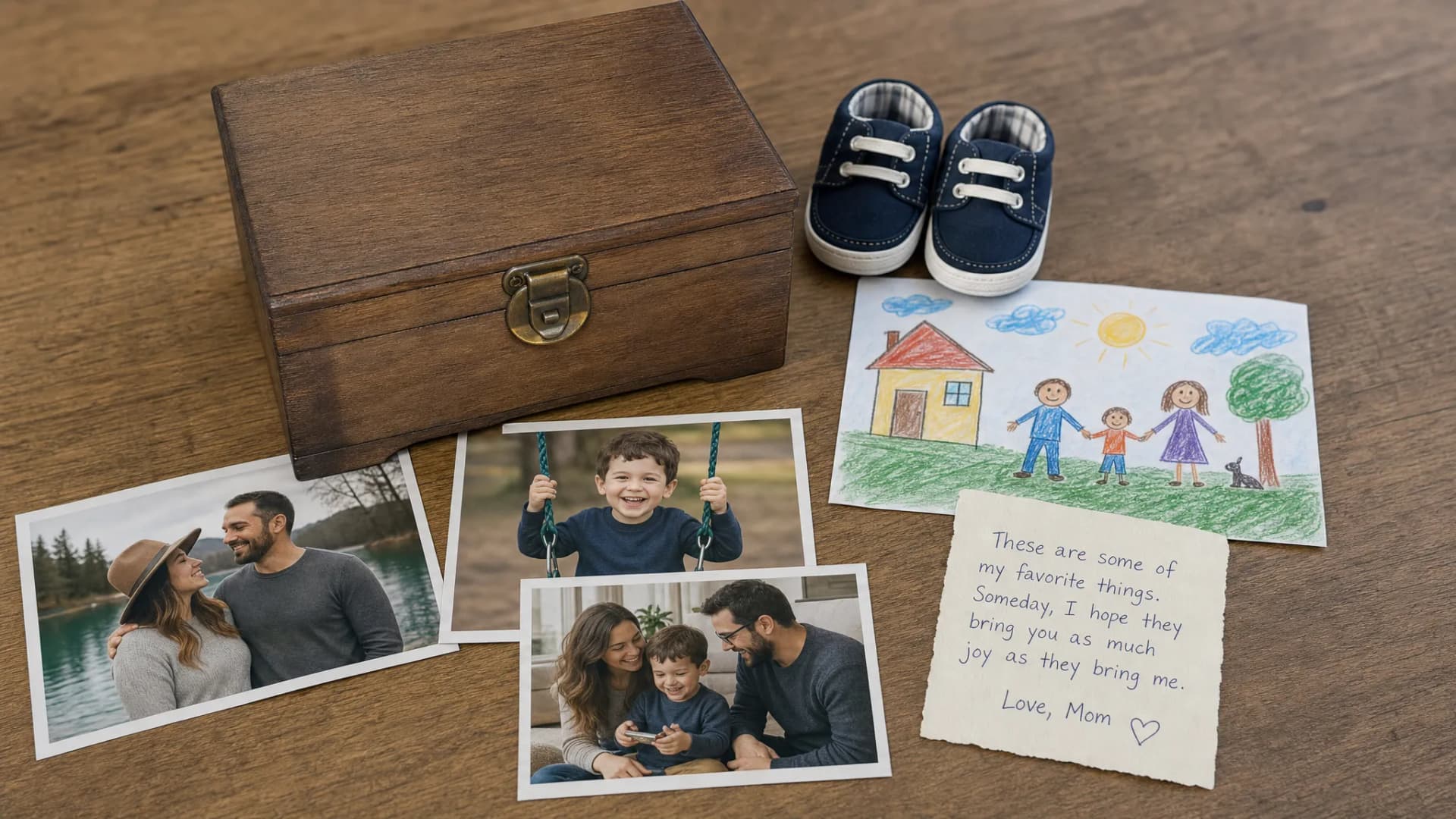
Printing a small selection changes the relationship you have with your memories. A printed photo can be held, placed in a box, tucked into a journal, framed on a shelf, or handed to a child who wants to know, “What was I like when I was little?”
You do not need to print everything. Try a rhythm that feels sustainable:
| Rhythm | Simple practice | Best for |
|---|---|---|
| Monthly | Print 5 to 10 favorite photos | Parents who like steady routines |
| Seasonally | Print photos from spring, summer, fall, and winter | Families who think in school-year seasons |
| Yearly | Make one small album or envelope of highlights | Parents who prefer one annual task |
When choosing photos, include more than posed smiles. Save the ordinary scenes too: messy hair at breakfast, muddy shoes by the door, couch forts, bedtime books, little hands helping in the kitchen. These are often the images that carry the texture of family life.
Record Tiny Videos and Voice Notes
Photos preserve faces and places. Video and audio preserve movement, rhythm, and sound.
A ten-second clip of your toddler saying a favorite word may become more precious than a long, polished video. A voice note of your child singing in the car, telling a story, or explaining how the world works can bring back a season instantly.
Keep recordings short and intentional. Long videos are harder to sort and revisit. Tiny clips are easier to save, label, and enjoy.
A simple file name can make a big difference. Instead of leaving a video named with random numbers, rename a few favorites with the year and description, such as “2026 – Nora singing bedtime song” or “2026 – Mateo explains dinosaurs.”
Build Memory Keeping Into Existing Family Traditions
The easiest memory habits are attached to things you already do. Rather than creating a separate project, let memory keeping ride along with birthdays, holidays, school transitions, and seasonal rituals.
You might write a birthday letter each year, take a photo on the first and last day of school, save one ornament-related story each December, or ask the same three questions every New Year’s Eve.
For example:
- What do you love right now?
- What was something hard this year?
- What do you want to remember?
The answers do not need to be profound. In fact, simple answers are often the most revealing. A child who says their favorite thing is “macaroni, my red socks, and when Dad makes dragon sounds” has given you a perfect snapshot of that age.
If you want more gentle prompts and ideas over time, the Tiny Moments Kept articles collection gathers essays and guides around keepsakes, memories, and simple systems for family life.
Protect Digital Memories With a Basic Backup Habit
A memory system should be emotionally meaningful, but it also needs to be practical. Phones break. Laptops fail. Cloud accounts change. A little backup care can protect the photos and videos you truly want to keep.
The Library of Congress recommends thinking carefully about storage conditions for family treasures and taking steps to preserve materials before damage happens. For digital memories, the same spirit applies: choose what matters, store it in more than one place, and check it occasionally.
A simple backup habit might include keeping your favorite photos in cloud storage, saving a second copy on an external drive, and printing a small number of irreplaceable images. You do not need a complex archive. You need a plan that you can actually maintain.
Once or twice a year, set aside 30 minutes to move favorite photos and videos into a folder labeled by year. Delete obvious duplicates if you have energy. If not, simply gather the best ones. Progress matters more than perfection.
Revisit the Memories, Not Just Store Them
Preserving childhood memories is not only about saving them for “someday.” Memories become more valuable when they are woven back into family life.
Place a small photo album where your child can reach it. Pull out the memory box on a birthday. Read last year’s birthday letter before writing the next one. Let your child hear old voice notes. Tell the story behind the tiny shoes or the drawing with the giant purple sun.
This is where memory keeping becomes relational. Children often love hearing about who they were when they were younger. It gives them a sense of continuity and belonging. It says, “Your life has been noticed. Your small moments mattered.”
Revisiting can also help parents. In the rush of daily care, it is easy to feel like the days are only tasks. Looking back gently can reveal the love that was present all along.
A Simple Monthly Memory Routine
If you want a clear starting point, try this once-a-month routine. It takes about 20 minutes and can be done from your phone.
- Choose 5 favorite photos from the month.
- Write one short note about a moment you do not want to forget.
- Save one quote, phrase, or funny thing your child said.
- Move the photos and note into a folder labeled with the year.
- Print one photo if you can.
That is enough. Truly.
If you repeat this for a year, you will have 60 selected photos, 12 written memories, 12 quotes, and a small stack of printed images. That is a beautiful record of childhood, and it is far more approachable than trying to organize everything at once.
What to Let Go Of
One of the kindest things you can do for your future self is release the idea that every memory must be preserved.
You can let go of blurry duplicates, worksheets with no personal meaning, party favors, broken crafts, and photos that do not stir recognition or feeling. You can let go of the pressure to make a baby book exactly on time. You can let go of the belief that a good parent keeps everything.
A good parent notices. A good parent loves. A good parent sometimes saves the tiny sock and sometimes takes a photo before recycling the paper crown.
The memory is not only in the object. It is also in the attention you gave it.
Frequently Asked Questions
What is the easiest way to preserve childhood memories? The easiest way is to choose one meaningful photo or moment at a time and add a little context. A simple monthly habit of saving a few photos, one quote, and one written memory is enough to build a rich family archive.
How many childhood keepsakes should I keep? There is no perfect number. A helpful guideline is to keep what still carries a clear feeling, story, or milestone. If an item does not help you remember your child or that season of life, it may not need to stay.
Should I keep all of my child’s artwork? You do not need to keep every piece. Choose a small number of favorites from each year, photograph others, and release the rest. This makes the artwork you do keep easier to enjoy and revisit.
How can I organize digital photos without getting overwhelmed? Start by organizing only your favorites. Create folders by year, move your most meaningful photos into them, and back them up in more than one place. Avoid starting with your entire camera roll if that feels too big.
What if I am already years behind? Begin with the current month. You do not have to catch up before you start. Once you have a simple habit in place, you can slowly gather older memories when you have time and emotional energy.
Begin With One Tiny Moment
You do not need a perfect system to begin preserving childhood memories. Choose one photo from this week. Write down what was happening, what your child said, or what you want to remember about this season. Put it somewhere safe.
That small act is memory keeping.
Over time, these tiny moments become a quiet treasure: a record of ordinary love, carefully kept. For more gentle guidance on preserving family memories without overwhelm, visit Tiny Moments Kept and start with the moments that already feel warm in your hands.