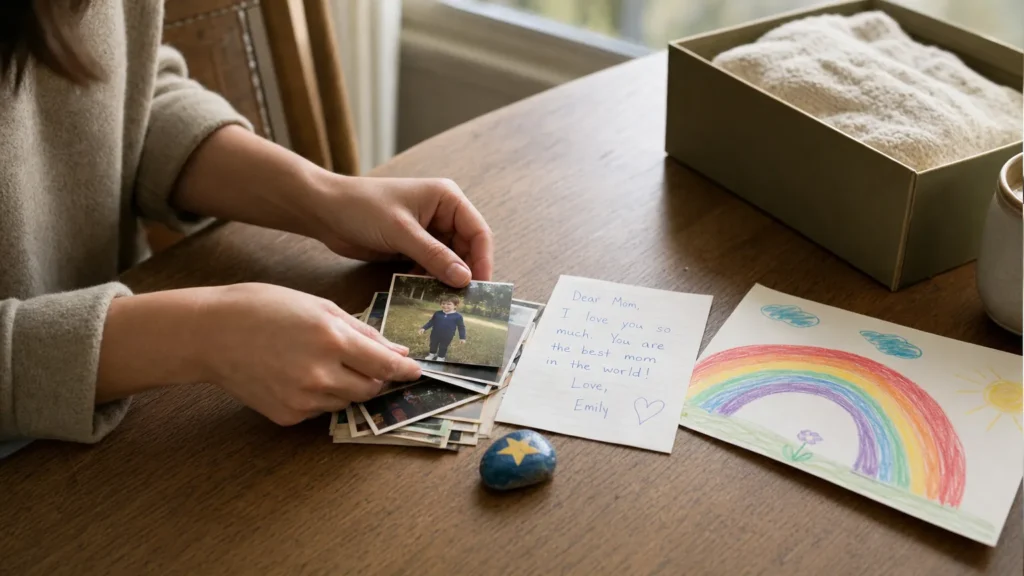
The days you most want to remember often do not announce themselves. They happen while you are rinsing blueberries, buckling car seats, looking for a missing sock, or listening to a child tell a story that begins nowhere and somehow becomes the whole afternoon.
Then, suddenly, a season has passed. The tiny rain boots are too small. The favorite stuffed animal has moved from constant companion to shelf friend. The mispronounced word corrects itself. You realize the childhood days you thought you were living inside of are already becoming memory.
Holding on does not mean saving everything. In fact, trying to keep every photo, paper, drawing, and souvenir can bury the very feeling you hoped to preserve. A gentler way is to learn how to notice what matters, keep it with care, and return to it often enough that it remains part of family life.
Start by letting ordinary moments count
Many parents feel pressure to document milestones: birthdays, first steps, school programs, vacations, holidays. Those are worthy, of course. But the best of childhood is often hidden in repetition.
The same bedtime song. The way your child says your name when half asleep. Saturday pancakes. The rock collection in a jacket pocket. The drawing taped to the fridge for so long that everyone stops seeing it.
These are not lesser memories. They are the texture of home.
If you only preserve big events, your archive may look impressive but feel incomplete. Ordinary moments carry the warmth of what daily life actually felt like. They help you remember not just what your child did, but who they were becoming and who you were together.
A useful question is: what would I miss if it quietly disappeared tomorrow?
That question helps you notice the little things while they are still alive in the room.
Decide what the best means before you keep more
The best of childhood days does not always mean the prettiest photo or the most impressive achievement. Sometimes the best memory is blurry, messy, or unfinished. It may be a grocery list with a child’s scribble at the bottom, a muddy snapshot, or a note that only makes sense to your family.
Before saving another pile of things, pause and define what is worth keeping in your home. This gives your memory keeping a center. It also makes it easier to release the rest without guilt.
| A memory worth keeping often has… | What it might look like |
|---|---|
| A strong feeling | A photo that brings back warmth, tenderness, surprise, or laughter |
| A family phrase | A note with a funny saying, nickname, or mispronounced word |
| A small ritual | Pancake mornings, bedtime routines, walks, seasonal traditions |
| A sign of growth | First writing attempts, a self-portrait, a favorite book list |
| A sensory detail | A pressed flower, a recipe card, a note about how the house smelled that day |
| A connection | A memory of siblings, grandparents, friends, pets, or quiet one-on-one time |
This kind of choosing is not about making childhood look perfect. It is about preserving what still feels alive when you hold it.
Use a small capture habit, not a giant project
Busy parents rarely need a more complicated system. They need a rhythm small enough to survive real life.
Try keeping one simple place for unsorted memories. It might be a folder on your phone, a small box on a shelf, a notes app, or an envelope in the kitchen drawer. The goal is not to organize immediately. The goal is to prevent meaningful things from scattering.
When something touches you, capture it in one of three ways:
- Take one photo and resist taking twenty.
- Save the physical item only if it carries a feeling you can name.
- Write one sentence of context while you still remember why it mattered.
That last part is powerful. A photo of a child holding a pinecone is sweet. A photo with the note, she carried this all the way home because she said it was a tiny tree sleeping, becomes a doorway.
Context turns a saved object into a remembered moment.
If you want a more structured version of this philosophy, Tiny Moments Kept shares a minimalist approach to meaningful memory keeping that pairs well with this kind of gentle, selective practice.
Choose one memory anchor for each season
One of the easiest ways to hold on without overwhelm is to choose a seasonal anchor. Instead of trying to summarize every month, ask: what is the one memory that feels like this season?
For spring, it may be muddy knees and chalk dust on the driveway. For summer, popsicle stains and late baths. For fall, backpack nerves and leaf piles. For winter, blanket forts and the sound of small feet waking before sunrise.
A seasonal anchor can be a printed photo, a short note, a child’s drawing, or a tiny keepsake. What matters is that it represents the feeling of that time.
You can store these anchors in a simple annual envelope or box. Label them by year, not by perfection. Childhood does not need museum-level preservation to be loved well.
Add words, even if they are imperfect
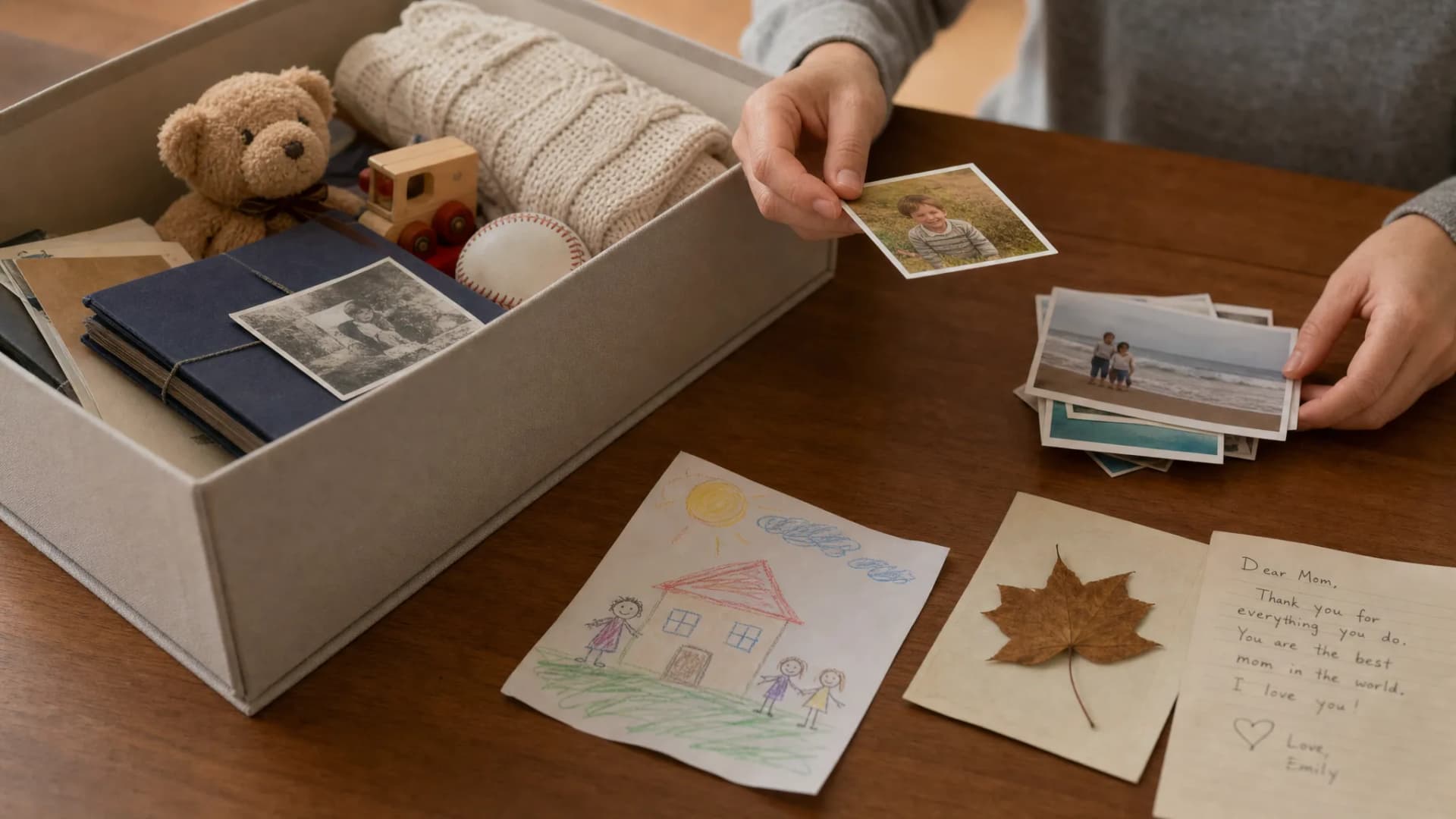
Photos show what happened. Words help explain why it mattered.
You do not need polished journaling. You do not need poetic captions. A few honest lines are enough. The most valuable memory notes often sound simple:
- You asked to wear the yellow raincoat even though there was no rain.
- This was the week you learned to whistle and practiced everywhere.
- You called strawberries heart berries, and none of us corrected you for a while.
- We were late, everyone was tired, and somehow this was still the sweetest morning.
These notes preserve tone, humor, and tenderness. They also remind your future self of details that photos cannot hold: the sound of a voice, the emotional weather of the day, the private meanings only your family knew.
The Harvard Center on the Developing Child describes the importance of back-and-forth connection in a child’s development. Memory keeping can become a quiet extension of that connection. When you notice, name, and later retell small moments, you show your child that their life is seen.
Let some things go with gratitude
One of the hardest parts of preserving childhood is accepting that you cannot keep it all.
Every parent eventually faces the overflowing bin, the thousands of phone photos, the stack of school papers, the tiny clothes that still seem to hold the shape of a child who has grown. Letting go can feel like betrayal. But keeping everything often makes it harder to find what matters most.
A helpful Japanese-inspired idea here is natsukashii, a warm and tender nostalgia. It is the feeling of remembering something with fondness, even as you know it belongs to another time. This feeling can guide you gently. You do not need to possess every trace of the past to honor it.
When deciding whether to keep something, try asking:
- Does this bring back a specific memory, or am I keeping it from guilt?
- Would one example represent many similar items?
- If my child saw this years from now, would it tell them something meaningful?
- Can I photograph it and release the object?
Letting go is not erasing. It can be an act of care. By clearing away the excess, you make room for the treasures, the true takaramono, to be found again.
Revisit memories while childhood is still happening
Many family archives become silent. Photos sit in the cloud. Boxes stay closed. Baby books wait for a perfect afternoon that never arrives.
The best memory keeping is not only about saving for someday. It is about bringing memories back into the present.
Choose small, repeatable ways to revisit what you keep. Look through a few printed photos on a rainy afternoon. Tell the story behind an ornament while hanging it. Read a note from last summer before starting a new one. Let your child see their old drawings and hear what you loved about that season.
This helps children understand their own story. It also helps parents feel the continuity of family life. You begin to see that childhood is not one vanishing thing, but a chain of tiny moments, each one connected to the next.
Revisiting also protects you from the pressure to document constantly. When you know you will return to what you save, you naturally become more selective. You keep what you want to meet again.
Create a simple home for the best memories
A memory does not need an elaborate system, but it does need a place to land.
Consider keeping three simple categories:
| Memory type | Simple home | Why it works |
|---|---|---|
| Photos | One folder of favorites per year | Makes printing or revisiting easier |
| Paper keepsakes | One envelope or slim folder per child per year | Prevents school papers from taking over |
| Tiny objects | One small keepsake box | Limits what you keep while honoring special items |
| Words | A note on your phone or a small journal | Captures the stories behind the images |
The limits are part of the kindness. A small box asks you to choose. A yearly folder gives the memories a boundary. A note with a date saves the feeling before it fades.
This is not about becoming perfectly organized. It is about creating enough order that love can be found again.
Keep the child, not just the performance
Modern childhood can easily become documented as a series of achievements: the concert, the award, the certificate, the first day, the best costume, the winning goal. These are joyful, but they are not the whole child.
Make room for memories that show personality rather than performance.
Keep the photo of your child lining up toy animals by size. Save the note about the question they asked in the car. Remember the way they insisted on bringing three stuffed animals to breakfast. Preserve the drawing that makes no visual sense but came with a long explanation.
Years from now, these may be the memories that feel most alive.
They say: this is how you saw the world. This is how we loved you in the middle of an ordinary day.
Accept that holding on also means letting time move
There is a tender ache in memory keeping. You are saving what you love because it changes. The baby becomes a toddler. The toddler becomes a school-age child. The child becomes someone with more private thoughts, longer legs, and fewer requests to be carried.
The goal is not to stop this. The goal is to accompany it.
When you hold on to the best of childhood days, you are not trying to trap your child in the past. You are building a record of love that can grow with them. You are saying: these days mattered, and we were here for them.
That record does not have to be large. It only has to be true.
Frequently Asked Questions
How do I choose which childhood memories to keep? Keep the memories that carry a clear feeling, show your child’s personality, mark growth, or preserve a family ritual. If an item only creates guilt or clutter, consider photographing it and letting the original go.
What if I already have thousands of photos? Start by choosing favorites from one small time period, such as last month or one season. Do not try to organize everything at once. Select the images that bring back a specific story, then add a short note to the best few.
Should I keep every school paper and drawing? No. One or two meaningful examples from a season often tell the story better than a large stack. Choose pieces that show growth, personality, humor, or a moment your child was especially proud of.
How can I preserve memories if I am not crafty? You do not need crafts, albums, or decorative layouts. A folder of favorite photos, a small keepsake box, and a few written notes can preserve childhood beautifully.
How often should I revisit family memories? A few times a year is enough. Try looking through seasonal photos, reading old notes on birthdays, or choosing one evening near the end of the year to remember favorite moments together.
A gentle next step
Tonight, choose one tiny moment from the day and write one sentence about it. Not the perfect moment. Not the most impressive one. Just the one that feels warm when you think of it.
That is how memory keeping begins to feel less like another task and more like a way of paying attention.
For more quiet ideas on preserving family life without overwhelm, you can browse the articles on Tiny Moments Kept and keep building a system that fits the season you are actually living.