Minimalist Approach for Meaningful Memory Keeping
If you’re a parent with thousands of photos on your phone, a drawer full of school papers, and a quiet sense that you’re “behind” on preserving your family’s story, take a breath.
You do not need a perfect scrapbook system, a craft closet, or hours every weekend to keep memories well. What you need is a gentler, more intentional way to decide what matters, save it simply, and make it easy to revisit.
That is the heart of a minimalist approach to memory keeping.
At Tiny Moments Kept, we believe memory keeping should feel like love, not pressure. It should reduce clutter rather than create it. It should help busy parents hold onto what is meaningful without turning family history into another unfinished project. And ideally, it should feel calm – practical on the surface, deeply emotional underneath, with the kind of quiet beauty found in Japanese-inspired simplicity.
What a Minimalist Approach to Memory Keeping Really Means
Minimalist memory keeping is not about caring less.
It is about choosing with care.
Instead of trying to save every photo, every drawing, every birthday card, and every tiny milestone, you create a simple system that preserves the moments with the most emotional meaning. You keep what helps you remember the feeling, the story, and the season of family life.
In practice, that often looks like:
- fewer photos, chosen more intentionally
- fewer physical keepsakes, stored more beautifully
- more stories and context, not just piles of items
- simple routines that are easy to maintain
- memory collections that can actually be seen, shared, and revisited
This is where many traditional memory-keeping systems fall short. They often focus on saving more, when what overwhelmed parents need is a way to save better.
Why Parents Feel So Overwhelmed by Memory Keeping
Most parents are not lazy. They are overloaded.
You are living the moments, documenting the moments, managing family logistics, and then carrying the invisible pressure of someday turning all of it into something meaningful. That is a lot.
Competitor articles often talk about editing photos, using digital tools, or simplifying layouts. Those are helpful ideas. But many gloss over the emotional weight behind memory clutter: guilt, perfectionism, fear of forgetting, and the sense that if you do not save everything, you might lose something precious.
A better approach starts by naming the real problem:
1. Too much input
Phones make it easy to capture everything. That convenience is wonderful – but it also creates massive digital overflow.
“Approximately 70% of photos taken on camera phones are never revisited.” – Digital Camera World
2. Too many decisions
Every memory item becomes a tiny emotional choice: keep it, toss it, scan it, label it, print it, file it, maybe deal with it later. Those choices pile up.
“When consumers were presented with 24 jam varieties, only 3% made a purchase, whereas offering just six options resulted in a 30% purchase rate.” – IESE Business School
That study is not about baby photos, of course, but the principle is the same: too many options create friction. In memory keeping, friction becomes procrastination.
3. Too much pressure to do it beautifully
Some parents stop before they start because they imagine memory keeping has to become a polished hobby. But meaningful memory keeping does not require elaborate design. It requires a repeatable rhythm.
The Real Benefits of a Minimalist Memory System
A simpler system does more than save space.
It reduces decision fatigue
When you know your personal rule – such as one photo book per year, one keepsake box per child, or one school page per month – you no longer have to reinvent the process each time.
It keeps memories visible
The goal is not to hide family memories in bins and hard drives. The goal is to make them easy to view and revisit. A small annual album on a shelf will be opened more often than a box in the attic.
It lowers the chance of unfinished projects
The more elaborate the system, the more likely it is to stall. Minimal systems get finished, and finished projects become family treasures.
It protects emotional meaning
When everything is saved, nothing stands out. When you choose carefully, the most important stories breathe.
It supports a calmer home
Physical clutter and digital clutter both create low-grade stress. A memory system that is light, contained, and intentional can feel emotionally relieving.
The Tiny Moments Kept Philosophy: Keep Less, Feel More
At Tiny Moments Kept, we encourage parents to think of memory keeping less like storage and more like curation.
That means asking:
- What would I be sad not to remember?
- What tells the story of who my child is right now?
- What would my child love to revisit later?
- What object, image, or sentence captures this season best?
This way of thinking blends practical organization with a soft, reflective sensibility. It is inspired by the idea that ordinary family life becomes precious when we notice it with tenderness.
You do not need to preserve every moment.
You only need to preserve the moments that carry the whole feeling.
The 5-Part Minimalist Formula for Meaningful Memory Keeping
Many competitor articles touch on curation, digital storage, or simple design. What is often missing is a complete framework parents can actually follow. Here is one.
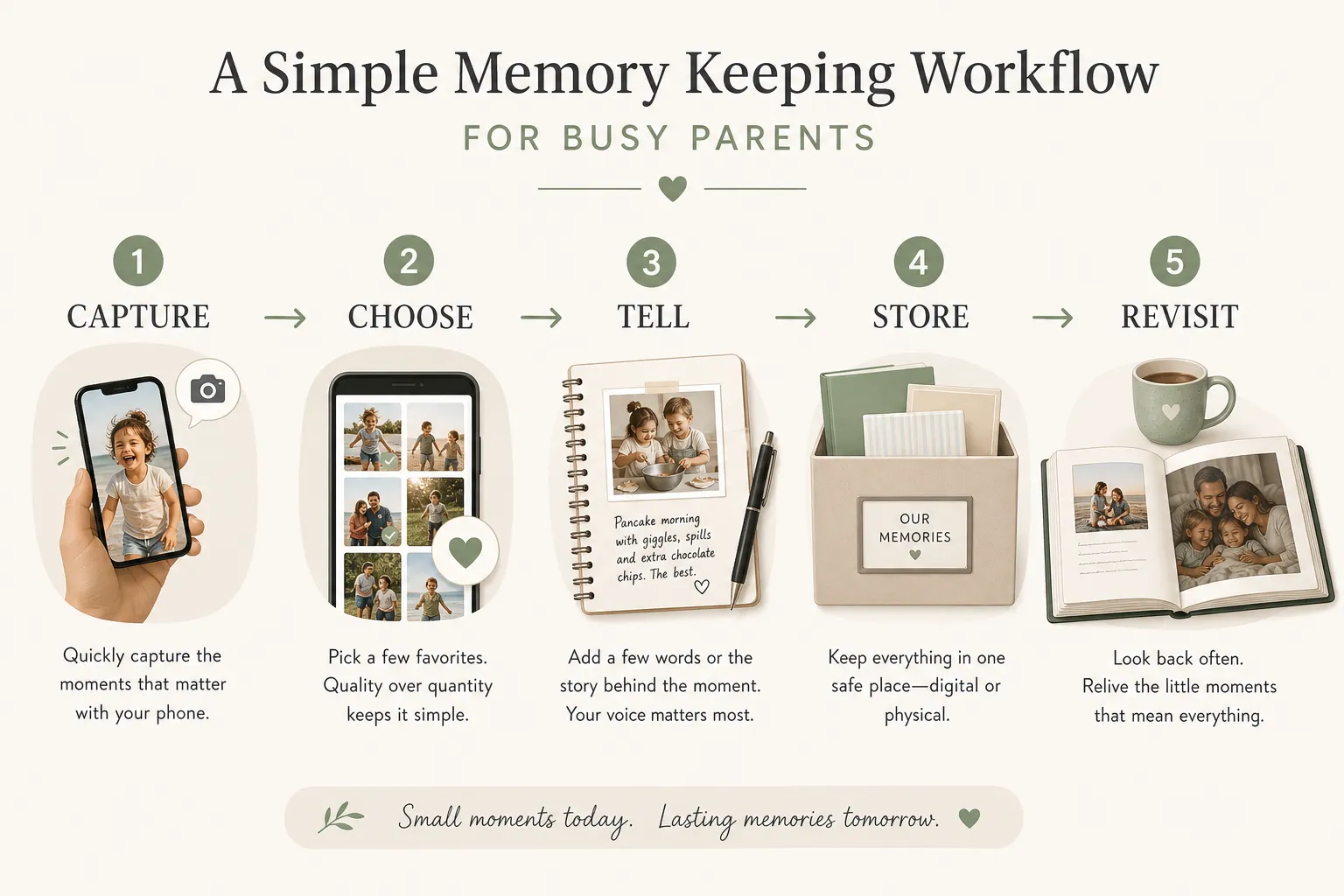
1. Capture generously, but keep selectively
Take all the photos you want in the moment. Be free while living your life.
But later, shift roles. Become an editor.
Instead of asking, “Should I save this too?” ask:
- Does this image tell a story?
- Is it emotionally distinct from the others?
- Will I still care about this in five years?
- Does it show personality, connection, or change?
A useful rule is to keep the best example, not every example.
2. Save stories, not just stuff
A drawing matters more when you know it was the “first time she drew our family with the dog included.” A blurry photo becomes special when you remember “this was the morning he insisted on wearing rain boots to preschool.”
Objects alone are not enough. Add context:
- a date
- a sentence
- a short note
- a voice memo
- a caption in a photo book
Memory keeping becomes meaningful when stories stay attached to the artifacts.
3. Contain each category
Minimalism works best when memory collections have boundaries.
Try simple containers like these:
| Memory Type | Suggested Limit | Why It Helps |
|---|---|---|
| Printed photos | 1 annual family album | Easy to finish and revisit |
| Child artwork | 1 slim portfolio or box per year | Prevents paper overflow |
| School keepsakes | 10–15 items per school year | Encourages thoughtful selection |
| Baby items | 1 small keepsake box | Protects meaning without excess |
| Digital photo favorites | 20–50 per month | Makes future projects manageable |
Boundaries do not make memories less valuable. They make them more visible.
4. Design simply and consistently
Across the top competitor content, a clear pattern appears: simpler layouts create calmer, more timeless memory projects.
That is worth keeping.
You do not need trendy embellishments or busy pages. A consistent style is enough:
- white space
- neutral tones
- one or two clean fonts
- simple captions
- chronological flow
- high-quality but not excessive printing
A calm visual style helps the emotions come forward. This is one of the quiet strengths of Japanese-inspired design: restraint creates room for feeling.
5. Revisit regularly
This is the step many articles barely mention, even though it may be the most important.
A memory is not fully kept just because it is stored. It becomes alive when it is revisited.
Create small rituals:
- flipping through the annual album on birthdays
- opening the keepsake box once each season
- reading a note from last year at New Year’s
- letting children choose their favorite photo from the month
The point is not just to archive family life. It is to live with your memories.
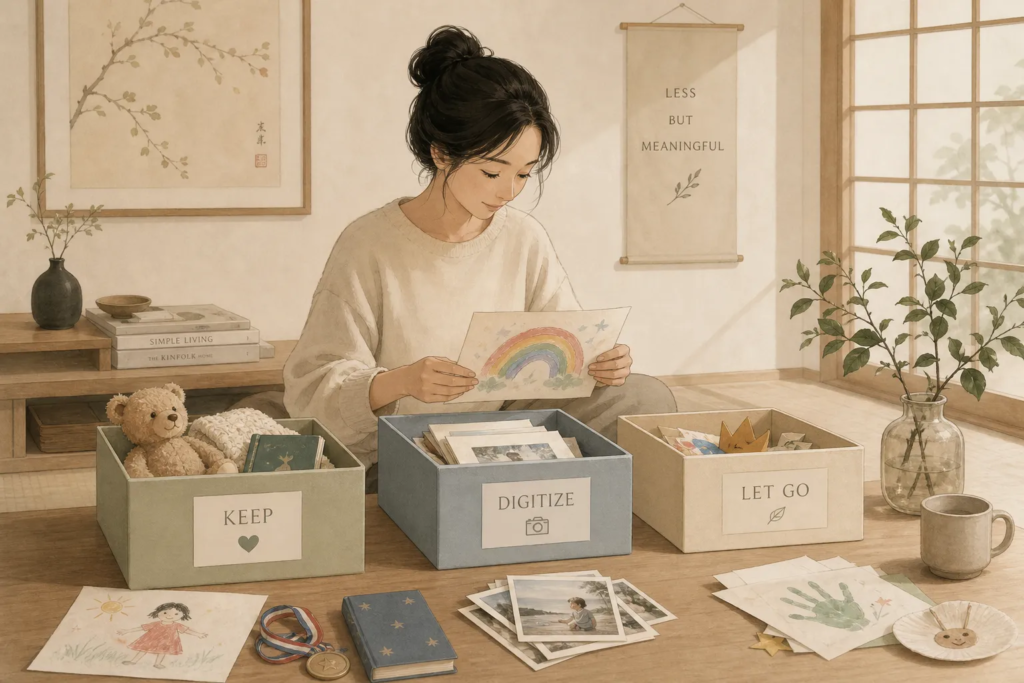
What to Keep, Digitize, or Let Go
One of the hardest parts of memory keeping is deciding what deserves physical space. This simple framework helps.
Keep physically if it is:
- irreplaceable
- emotionally powerful
- tactile in a meaningful way
- small enough to store well
- representative of a milestone or season
Examples:
- a hospital bracelet
- one favorite newborn outfit
- a letter from your child
- one truly special drawing
- a meaningful handmade card
Digitize if it is:
- valuable mainly for the image or information
- too bulky to keep
- one of many similar items
- useful for a future photo book or montage
Examples:
- school worksheets
- everyday artwork
- birthday cards
- certificates
- vacation brochures or paper mementos
Let go if it is:
- duplicated
- damaged without emotional significance
- saved from guilt rather than love
- something you forgot you even had
- not telling any meaningful story
This is not about being ruthless. It is about being honest.
A Gentle Workflow for Busy Parents
The best system is the one you can repeat during ordinary life.
Here is a simple rhythm we recommend at Tiny Moments Kept:
Weekly: choose a few highlights
Spend 10 minutes selecting favorite photos from your phone. Mark a handful as monthly keepers.
Monthly: add a sentence or two
Write down one story, one funny quote, one hard-won milestone, or one tiny detail you do not want to forget.
Seasonally: sort physical keepsakes
Go through papers, art, cards, and small items. Keep only the strongest representatives.
Yearly: create one finished piece
Turn the year into an album, a slim family yearbook, or a curated memory box.
That one finished piece matters more than dozens of half-started projects.
Minimalist Memory-Keeping Ideas That Actually Work
Here are practical formats that suit a calm, low-clutter family life.
Annual family photo book
This is one of the most effective options for modern parents. One book per year is finite, satisfying, and easy to revisit.
Best for:
- family milestones
- everyday photos
- travel highlights
- captions and short stories
One keepsake box per child
Choose one beautiful, compact box. When it is full, something must be edited out before something new comes in.
Best for:
- baby items
- letters
- special cards
- a few small treasures
School memory binder
Use one slim binder with plastic sleeves or folders. Keep a curated selection instead of every paper that comes home.
Best for:
- report cards
- a few writing samples
- class photos
- standout artwork
Seasonal photo ritual
Print a small set of photos every season and store them in one album or display frame that rotates.
Best for:
- families who want low effort
- grandparents
- making memories visible at home
Digital story archive
Use a notes app, private family folder, or simple document where you record quotes, milestones, and funny moments.
Best for:
- parents who are short on time
- preserving context alongside photos
- future album creation
How to Choose the “Right” Photos Without Overthinking
This is where many parents get stuck. The answer is not to become stricter. It is to become clearer.
Choose photos that do one or more of these things:
| Choose Photos That… | Why They Matter |
|---|---|
| Show connection | Relationships are the heart of family memory |
| Capture personality | These images feel specific, not generic |
| Mark change over time | Growth is part of the story |
| Hold emotional atmosphere | They bring back the feeling of the day |
| Represent ordinary life | The everyday often becomes the most treasured later |
You do not need all smiling faces, perfect lighting, or milestone moments. Some of the most meaningful photos are quiet and imperfect: toast crumbs, pajama mornings, muddy shoes at the door, a child asleep in the car.
What Competitor Articles Often Miss
After reviewing the leading content in this space, a few consistent gaps stand out.
They focus on organizing, but not enough on emotion
Minimalist memory keeping is not just a decluttering strategy. It is an emotional practice of noticing what is worth carrying forward.
They say “go digital,” but do not explain what becomes tangible again
Digital storage is useful, but parents still need finished, visible formats that invite remembering. Otherwise, memories remain buried in apps.
They recommend editing, but not decision rules
Parents need criteria, limits, and repeatable systems – not just the vague advice to “choose your favorites.”
They simplify design, but not identity
The best memory systems reflect the family’s values. At Tiny Moments Kept, that means warmth, restraint, beauty, and emotional clarity – not perfection.
A Calm Home Memory Corner Changes Everything
When memories are thoughtfully displayed, they become part of family culture rather than stored obligation.
A memory corner can be very small:
- one framed family photo
- one child artwork clip
- one seasonal object
- one slim album on a shelf
- one keepsake box nearby
That is enough.
This kind of setup quietly tells your family: our life matters, and we notice it.
A Simple Memory-Keeping Workflow You Can Start This Week
If everything feels scattered right now, begin here.
Step 1: Pick one category
Choose just one:
- phone photos
- school papers
- baby keepsakes
- holiday memories
- family traditions
Step 2: Set a container
Decide the limit before you sort:
- one album
- one box
- one folder
- one binder
- one document
Step 3: Choose the best representatives
Look for emotional weight, not volume.
Step 4: Add context
Write a short note, date, or caption.
Step 5: Finish something small
Make one mini album, one labeled box, or one monthly digital folder. Completion builds momentum.
A Sample Minimalist Memory Plan for One Year
If you want structure without overwhelm, this is a beautifully manageable starting point.
| Timeframe | Action | Time Needed |
|---|---|---|
| Weekly | Favorite 5–10 photos on your phone | 10 minutes |
| Monthly | Write one family note or milestone summary | 10–15 minutes |
| Quarterly | Sort children’s papers and keepsakes | 20–30 minutes |
| Yearly | Create one photo book and refresh keepsake box | 2–4 hours total |
This is sustainable. That matters.
Because the best memory system is not the most impressive one. It is the one still working for your family two years from now.
Why Minimalist Memory Keeping Feels More Meaningful Over Time
As children grow, parents often realize something tender: the memories they treasure most are rarely the most elaborate ones.
It is the way a toddler pronounced a word. The note tucked into a lunchbox. The tiny self-portrait with giant pink arms. The annual birthday photo where you can suddenly see they are not little anymore.
A minimalist approach helps you spot those moments sooner. It teaches you to preserve what is emotionally alive, not just what is available.
Final Thoughts: You Don’t Need to Save Everything to Keep What Matters
Meaningful memory keeping is not about more bins, more apps, more supplies, or more pressure.
It is about creating a home for the moments that matter most.
At Tiny Moments Kept, we believe the simplest systems are often the most lasting. When you choose carefully, store intentionally, and revisit often, your family memories become lighter to carry and richer to hold. You reduce clutter. You avoid unfinished projects. You make space for reflection. And you create keepsakes your family will actually return to.
If you are ready for a calmer way to preserve childhood memories – one rooted in simplicity, emotional meaning, and quiet beauty – Tiny Moments Kept is here to help you begin.
FAQ
What is the 2 7 30 rule for memory?
The 2 7 30 rule is a common review method for strengthening recall: revisit information after 2 days, 7 days, and 30 days. While it is usually used for learning, the idea also supports family memory keeping by reminding us that regular revisiting helps memories stay meaningful.
What are 5 effective memory strategies?
Five effective strategies are choosing selectively, adding context, organizing simply, revisiting often, and using visual cues like photo books or keepsake boxes. In family memory keeping, these habits make memories easier to preserve and actually enjoy later.
What is the strongest trigger to memory?
The strongest trigger is often emotion, especially when paired with a photo, object, scent, or story. That is why minimalist memory keeping focuses on saving the items and images that carry the deepest feeling, not just the largest quantity.
What are the 7 ways to improve memory?
Seven helpful ways include sleep, repetition, storytelling, visual association, reducing clutter, focused attention, and regular review. For parents, even a simple routine of choosing photos and writing a note each month can strengthen what is remembered.
What are the 4 C’s of memory?
The 4 C’s are often described as concentration, comprehension, connection, and consistency. In memory keeping, that translates to paying attention to family moments, understanding why they matter, linking them to a story, and using a repeatable system.
What is the #1 worst eating habit for memory loss?
A diet high in ultra-processed foods and added sugars is often linked to poorer brain health over time. While this article focuses on emotional and practical memory keeping, overall wellness – including nutrition – supports long-term memory too.