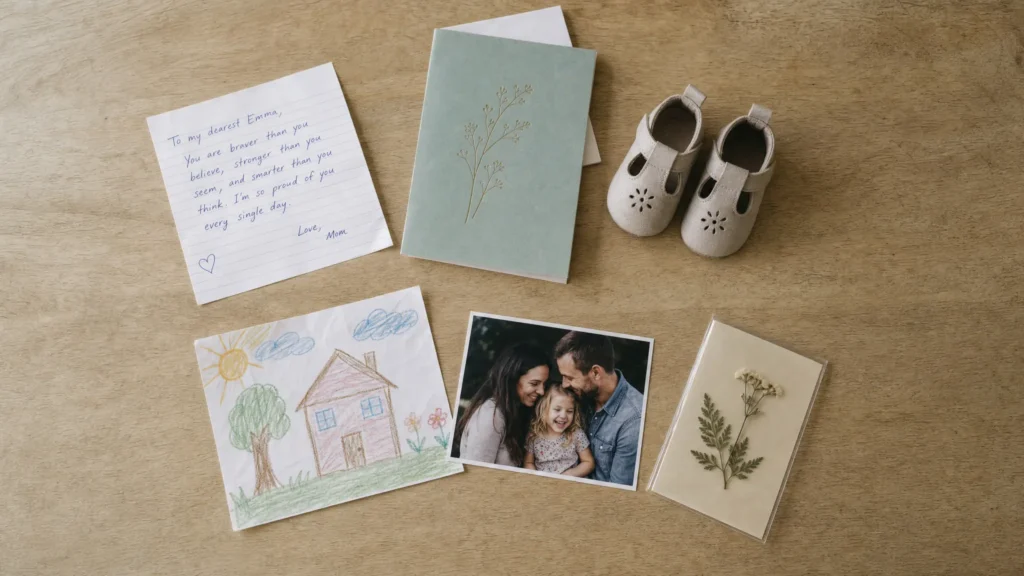
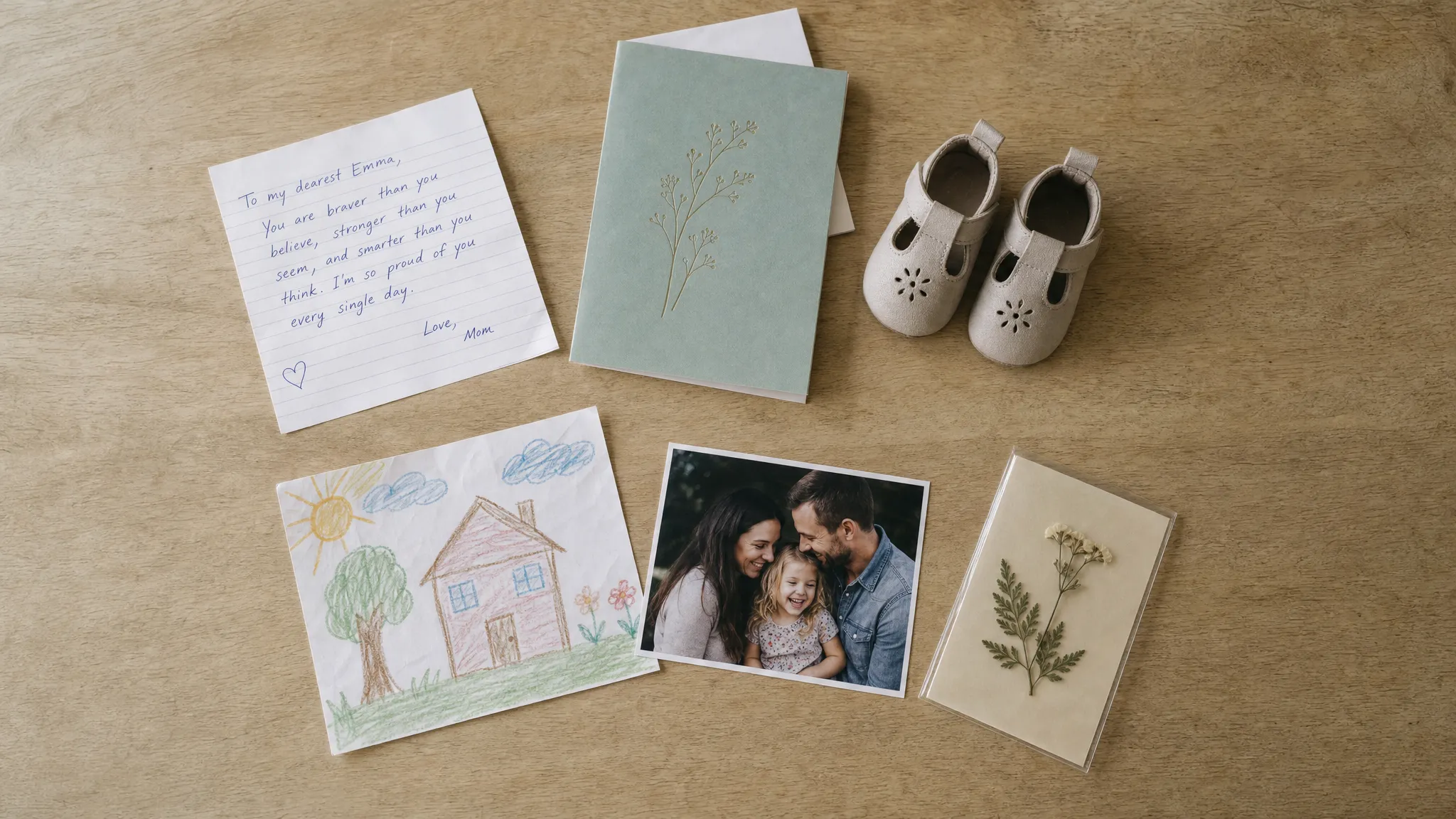
If you have ever opened a drawer and found a hospital bracelet, a stack of school papers, a tiny sock, three birthday cards, and a rock your child insisted was special, you already know the problem: family memories gather faster than parents can sort them.
The hard part is not finding keepsakes. The hard part is knowing which keepsakes matter most.
A meaningful keepsake is not always the prettiest item, the most expensive gift, or the thing that looks best in a memory box. Often, it is the small object that wakes up a whole season of family life. It holds a voice, a habit, a relationship, a before-and-after moment. It helps you remember not just what happened, but what it felt like to be there.
For busy parents, the goal is not to save everything from childhood. The goal is to preserve a few clear, warm doorways back into it.
What Makes a Keepsake Worth Keeping?
The word “keepsake” can make almost anything feel important. A receipt from a family outing, a party favor, a spelling test, a drawing, a tiny toy from the back seat. But an object becomes a true keepsake when it carries meaning beyond the object itself.
The best family keepsakes usually have three qualities.
They point to a specific story. When you hold the item, you can remember a moment, a place, a phrase, or a person. It does not feel vague. It brings something back.
They reveal connection. A keepsake that matters often says, “This is how we loved each other then.” It may show a child’s favorite ritual, a grandparent’s handwriting, a sibling bond, or the rhythm of ordinary home life.
They would be hard to recreate later. A printed photo can be replaced if there is a digital copy. A generic toy can often be found again. But a scribbled note from your child, a recipe card in your mother’s handwriting, or a well-loved bedtime book with taped corners carries a kind of irreplaceable presence.
This is why memory keeping becomes easier when you stop asking, “Is this cute?” and start asking, “What story does this help us remember?”
The Keepsakes That Matter Most for Family Memories
There is no universal list that fits every family. A military family, a blended family, a family with many moves, a family rooted in one home for generations, and a family navigating illness or loss will all treasure different things.
Still, certain types of keepsakes tend to hold lasting emotional value because they preserve identity, relationship, and change.
Threshold keepsakes from important transitions
Threshold keepsakes mark a passage from one stage to another. These are the small objects that say, “Life was different after this.”
A hospital bracelet, adoption day memento, first-day-of-school tag, house key from a first family home, moving announcement, graduation tassel, or tiny pair of shoes can all fall into this category. The point is not to keep one item from every milestone. The point is to choose the moments that changed your family’s shape.
For example, you may not need every preschool craft from the first month of school. But one name tag, one photo, and one sentence about how your child clung to your hand at drop-off can preserve the season more vividly than a full folder of papers.
Everyday objects that show family rhythm
Some of the most meaningful keepsakes are not from big events at all. They come from the repeated moments that made up daily life.
A bedtime book with a worn spine. The measuring spoon your child always used for pancakes. A small toy that appeared in every family road trip. A handwritten lunchbox note. A cloth napkin from Sunday dinners. These objects hold the warmth of repetition.
Parents often overlook everyday keepsakes because they seem too ordinary. But ordinary is where family life actually happens. Years later, the object that brings the strongest memory may not be from a perfect vacation. It may be the little book you read every night when everyone was tired and your child still asked, “One more time?”
Child-made keepsakes with voice or personality
Children produce a beautiful, overwhelming amount of paper. If you try to save all of it, the meaningful pieces can get buried. Instead, look for work that carries your child’s voice.
A self-portrait with enormous eyes. A spelling mistake that became a family joke. A note that says “I am mad but I still love you.” A drawing of the family where the dog is larger than the house. A list of favorite animals, dream jobs, or invented rules for a backyard game.
These pieces matter because they show how your child saw the world at a particular age. They preserve personality, not just productivity.
When choosing artwork, keep fewer pieces and add context. A date helps. A sentence helps even more: “You drew this during your ocean phase, when every animal had to be a whale.” That tiny note turns paper into memory.
Words, letters, and handwriting
Objects are powerful, but words often carry the heart of family memory.
Save a few cards, notes, letters, recipe cards, poems, or printed text messages that show real affection or family history. A grandparent’s handwriting can become priceless. So can a child’s early writing, especially when it captures a phrase they used to say out loud.
If your family does not naturally write letters, you can still preserve words in simple ways. Keep a small quote notebook. Write down funny phrases on index cards. Print a short email from a loved one. Save one birthday card with a meaningful message instead of twenty cards with only signatures.
A keepsake does not have to be old to become meaningful. Sometimes it just needs to preserve a voice.
Tradition tokens that connect one year to the next
Family traditions create continuity, and keepsakes from those traditions help children feel the thread between past and present.
This might be a holiday ornament, a pressed leaf from an annual walk, a candle stub from a yearly celebration, a handwritten menu from a birthday breakfast, or a recipe card used every winter. These items become more meaningful when they are revisited as part of the tradition itself.
A tradition token says, “We do this because it belongs to us.” It does not need to be elaborate. In fact, simple traditions are often the ones children remember most clearly.
Keepsakes from hard seasons, handled with care
Not all meaningful memories are sweet. Some keepsakes matter because they honor change, grief, courage, or repair.
A hospital band, a cast signed by friends, a condolence card, a photo from a last visit, a moving box label, or a note from a difficult school year may carry deep meaning. These items should be kept thoughtfully, especially when they involve a child’s private emotions or medical history.
For sensitive keepsakes, consider whether the item belongs in a shared family box or a more private envelope. Add context gently. You do not need to turn pain into a display. Sometimes the most loving choice is simply to make sure the story is not lost.
| Keepsake type | Why it often matters | Simple way to preserve it |
|---|---|---|
| Threshold object | Marks a clear before-and-after moment | Store with a date and one sentence of context |
| Everyday object | Captures family rhythm and ordinary love | Keep one representative item or photograph it in use |
| Child-made work | Preserves personality, voice, and development | Save a few pieces per season with short notes |
| Written words | Holds affection, humor, and handwriting | Keep cards, letters, or quote cards in envelopes |
| Tradition token | Connects years and generations | Store with the tradition or revisit it annually |
| Hard-season item | Honors resilience, grief, or change | Keep privately with careful context |
A Simple Test for Choosing What to Keep
When a drawer, bin, or shelf becomes too full, decision fatigue sets in. A simple test can make the choice less emotional and more kind.
Before keeping an item, ask yourself:
- Can I name the specific memory this object holds?
- Does it reveal someone’s personality, relationship, or growth?
- Would a photo and one sentence preserve the memory just as well?
- Would I be glad to explain this to my child when they are older?
If the answer is yes to the first two questions, the item may be worth saving. If the third question is yes, you may not need the physical object. If the fourth question feels uncomfortable, the item may need privacy, more context, or release.
This is especially useful for bulky items. A large school project, favorite cardboard creation, or oversized stuffed animal may have mattered deeply for one week. You can honor it with a photo, write down the story, and let the object go when your home needs the space.
For a broader framework around choosing less but keeping it more meaningfully, Tiny Moments Kept has a gentle guide to a minimalist approach for meaningful memory keeping.
How Many Keepsakes Does a Family Really Need?
There is no perfect number. Some families keep one small box per child. Some keep one family archive. Some keep a few envelopes by year. The container matters less than the boundary.
A boundary protects the memory from becoming clutter. When everything is saved, nothing has room to feel special. A small, intentional collection is easier to revisit, easier to move, and easier to pass on.
One helpful rule is to keep enough that your future self can feel the season, but not so much that your future self has to manage the season all over again.
If a box is full, do not immediately buy a bigger box. Open it first. You may find duplicates, vague items, or things that once felt important but no longer carry a story. Let the collection breathe.
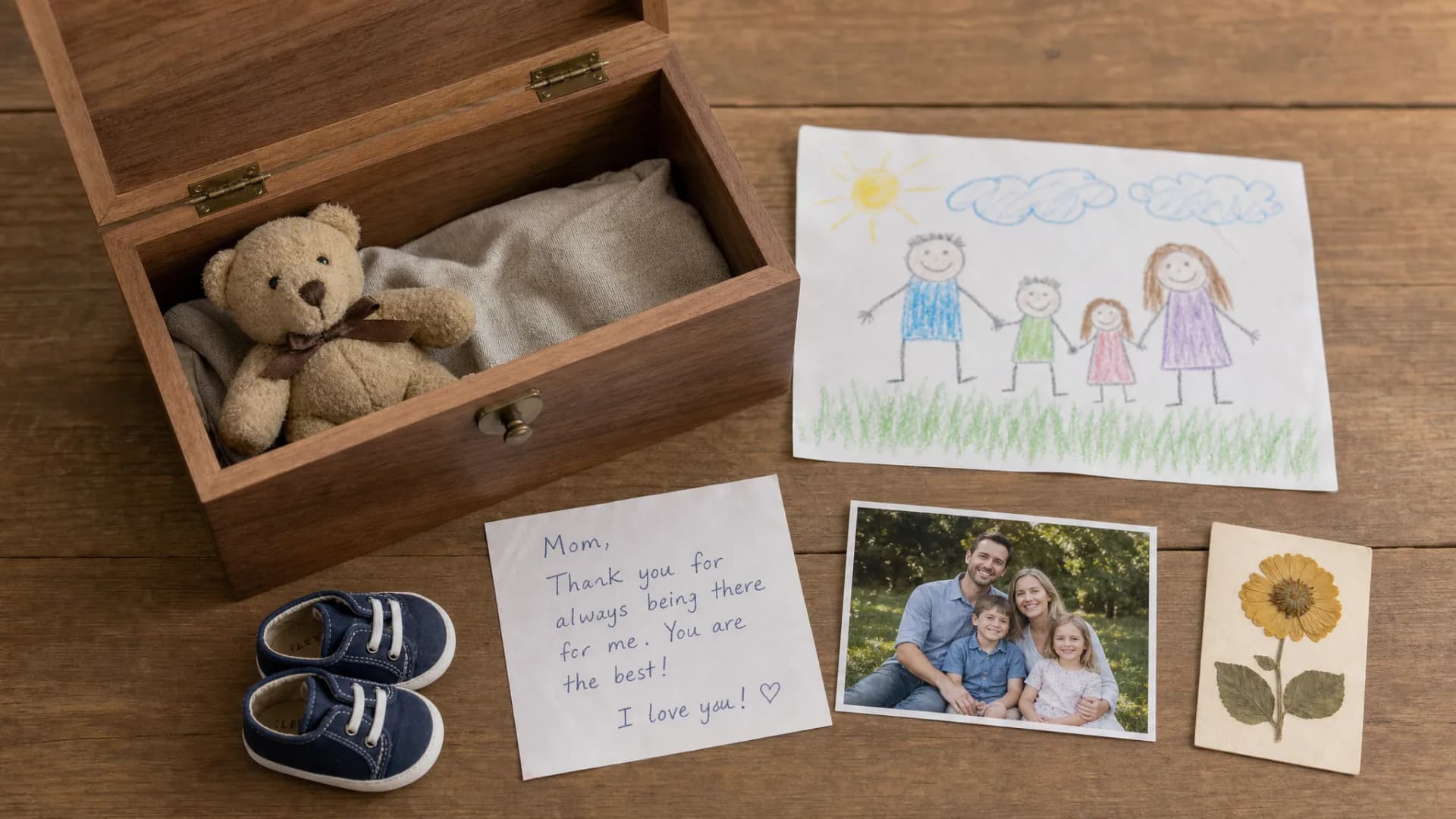
How to Store Keepsakes So They Can Be Revisited
A keepsake is not only something you save. It is something you can find again.
The simplest storage method is to pair each item with context. A beautiful object without a date or story can become mysterious later. A plain envelope with a note can become deeply moving.
For each meaningful keepsake, add the basics: who it belonged to, when it was from, where it came from, and why it mattered. You can write this on a small card and place it beside the item. For fragile photographs or papers, avoid writing directly on the front. A separate note is often safer and easier to read later.
For physical preservation, keep items clean, dry, and away from direct sunlight. The National Archives recommends storing family papers and photographs in stable environments and using appropriate archival materials when possible. In everyday parent terms, that usually means avoiding damp basements, hot attics, and random plastic bags that trap moisture.
You do not need a museum-quality setup to care well for family memories. A few acid-free folders, envelopes, labels, and a sturdy box can make a big difference. The most important habit is consistency. If every keepsake has a small note and a reliable home, your future family will understand what they are holding.
What to Do With Keepsakes You Cannot Keep
Letting go of a keepsake can feel like letting go of the memory. But the memory does not live only in the object. It also lives in the story you choose to preserve.
For items you cannot keep, try photographing the object in a way that shows scale or use. A photo of a paper crown on a table is fine. A photo of your child wearing it at breakfast is better. Add one sentence while the memory is fresh.
You can also invite your child into the process. Ask, “Which one of these feels most special to you?” Children are often more decisive than adults, and their answer may surprise you. They may choose the messy drawing over the polished certificate because the drawing carries a story you did not know.
For items connected to someone else, such as gifts, inherited objects, or handmade pieces, remember that gratitude does not always require permanent storage. You can take a photo, write down who gave it, and release the physical item with respect.
This is not careless. It is a way of keeping the treasure without letting the container take over the home.
Revisit Keepsakes, Do Not Just Store Them
Keepsakes matter most when they return to family life.
A memory box that is never opened can still have value, but a memory box that is revisited becomes part of the family story. You might open it on a child’s birthday, at the end of a school year, before a move, during the holidays, or on an ordinary rainy afternoon.
When you revisit keepsakes, ask simple questions. “What do you remember about this?” “Who gave this to us?” “What were you like then?” “What do you want to keep from this year?” These conversations help children understand that their lives are worth noticing.
Revisiting also helps parents. It can soften the ache of time passing. It can remind you that the tiny moments you were too tired to appreciate fully were still being gathered into love.
In a Japanese-inspired sense, a keepsake can feel like a small takaramono, a treasure. Not because it is perfect or rare, but because care has made it precious.
Frequently Asked Questions
What counts as a keepsake? A keepsake is any object, note, photo, or piece of writing kept because it holds personal or family meaning. It does not need to be expensive, beautiful, or traditional. It simply needs to carry a story worth remembering.
How do I decide which childhood artwork to keep? Choose artwork that shows your child’s personality, voice, interests, or development at a particular age. Instead of keeping every piece, save a small selection and write a short note about why each one mattered.
Should I keep one keepsake from every milestone? Not necessarily. Some milestones may be well documented with photos or words. Keep physical items from the moments that changed your family, carried strong emotion, or would be difficult to recreate later.
What if I feel guilty throwing keepsakes away? Guilt often comes from confusing the object with the memory. Try photographing the item, writing down the story, and thanking it for what it represented. Letting go can be part of caring for your home and your future self.
How should I label family keepsakes? Include the person’s name, date or approximate age, place, and why the item was saved. A short note such as “Your favorite bedtime book at age three” is often enough to make the keepsake meaningful years later.
A Gentler Way to Keep What Matters
The keepsakes that matter most for family memories are not the ones that prove you saved everything. They are the ones that help your family feel what was real: the small hands, the repeated rituals, the growing voices, the people who loved you, and the seasons that changed you.
Start small. Choose five items that still speak clearly. Add a note to each one. Let go of what no longer carries a story. Then place the remaining keepsakes somewhere they can be found again.
If you want more calm, parent-friendly ideas for preserving family memories without turning it into an overwhelming project, explore the memory-keeping articles at Tiny Moments Kept.